For engineering and platform teams
Typed AI decisions through an API
Ask your own tools a question with fixed options and get a probability for each, not free text. Keys, budgets and logs per project.

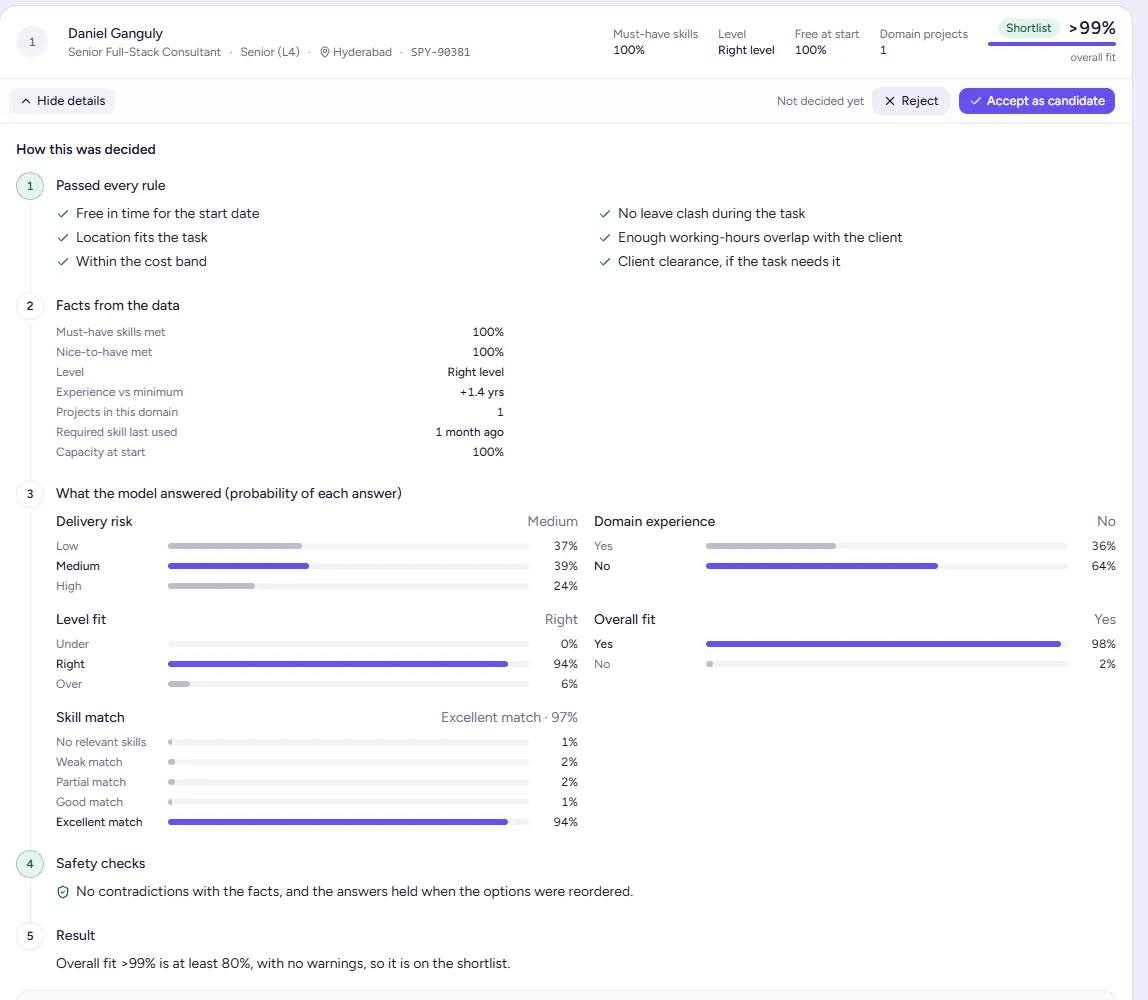
Short answer. If your own software needs an AI judgement, ask a question with a fixed list of options and take back a probability for each option, rather than parsing free text from a chatbot. FitRank's Decision API does that: you call a named question with its inputs, get a probability per option or an abstain, and every call is logged, rate-limited and counted against a monthly budget.
The problem with free text from a chatbot
Engineering and platform teams add AI to internal tools in a hurry: a prompt, a call, a string back. Then the string has to be parsed, the parsing breaks on a Tuesday, costs grow with usage, and nobody can say whether last month's answers were better than this month's. The answer cannot be tested because it was never a defined thing.
Many of these calls are not really open-ended. The code needs one of a few outcomes: approve or not, urgent or not, cheap model or strong model. Those are classifications, and they deserve an interface that returns a classification.
An illustrative example: approving a tool action
The service and the numbers are invented to show the shape of a call.
An internal agent wants to run a database export. Before it does, your code asks a typed question: should this action be approved? The options are fixed: yes or no. Back comes a probability for each, say a high one for yes and a small one for no. Your code has a rule that says above a chosen level it proceeds; between two levels it asks a person; below, it stops. If the model is unsure, the answer is an abstain, and your code treats an abstain as a reason to ask a person. The behaviour is something an engineer can test, because the output is a number and a list of options, not a paragraph.
How to design a typed AI call yourself
- Write the question so that it has a closed list of answers. If you cannot list the options, it is not a decision yet.
- Declare the inputs the question depends on and nothing else.
- Return a probability for every option, and allow abstaining when the model should not answer.
- Decide thresholds in your code, not in the model: what probability proceeds, what asks a human, what stops.
- Log every call with its inputs, output and version, so you can replay and compare.
- Cap spend and rate per project so a runaway loop cannot cost a month's budget in an hour.
- Keep sensitive attributes out of the inputs and refuse them if they appear.
How FitRank handles it
- The same typed-decision engine that powers matching is exposed to your other systems. See the Decision API.
- In the admin area you create a project and an API key. Each project has its own budget and rate limit.
- You call a question by name with its inputs, from your service or the Python client. Built-in questions include helping an AI agent choose a cheap or strong model, approve a tool action and check a result.
- Each question has a fixed list of options. You get back a probability for each, or an abstain when the model is not sure.
- Inputs that state protected attributes are refused.
- Every call is logged, rate-limited and counted against the project's monthly budget.
- The answers come from FitRank's own small model, trained for exactly these questions, running on an ordinary CPU rather than a hosted chatbot. See the in-house decision model.
The reasoning behind typed answers is covered in how it works, and the accuracy numbers for matching, which use the same model family, are on the results page.
A checklist for a typed AI call
- The question has a closed list of options and a named owner.
- The inputs are declared, and none is a sensitive attribute.
- Your code, not the model, decides what each probability range does.
- An abstain has a defined behaviour.
- Calls are logged with inputs, outputs and version.
- Rate limit and monthly budget exist per project.
- There is a test set of known cases, and you run it when anything changes.
Common mistakes
- Using a free-text answer and parsing it with a regular expression. It works until the wording shifts.
- Treating a probability as a certainty. Choose thresholds from your own tolerance for mistakes.
- Ignoring abstain. If it has no path in your code, you have simply hidden the uncertainty.
- Skipping the budget cap, then discovering a retry loop in the bill.
- Putting a person's identifying details in an input when the question does not need them.
When FitRank is not the right tool
The Decision API answers bounded questions with fixed options. It does not write text, summarise documents or hold a conversation, so if you need generation, you need a general language model. It is part of the Enterprise plan, with per-project keys and budgets, so it is not the way to try FitRank on a small pilot. And the built-in questions cover specific jobs; a question of your own that is far from staffing or agent control needs discussing with the team first.
Questions people ask
Can the API return free text?
No. It returns a probability for each of the question's options, or an abstain. That is what makes the answers testable.
Which plan includes the Decision API?
Enterprise, with per-project keys and budgets.
What happens when the model is not sure?
You get an abstain instead of a forced answer, and your code decides what to do with it.
Is every call logged?
Yes. Calls are logged, rate-limited and counted against the project's monthly budget.
Can I send protected attributes as inputs?
No. Inputs that state protected attributes are refused.
The features that do the work
More use cases
Be one of the first teams to staff with FitRank
We're taking on a small number of pilot companies. Pre-register for early access, or talk to us about an annual licence.