For delivery and talent leaders
Hire externally or move someone: how to decide
Compare the best internal person with the best outside candidate on fit, start date and margin. A method, a worked example and where it stops.

Short answer. To decide between hiring from outside and moving someone inside, compare the best person you already have with the best outside candidate on the same terms: fit to the task, the date each could start, and the margin on the work. FitRank builds that side-by-side card for every open task and gives a plain recommendation with reasons; the manager decides.
The decision nobody puts on one page
A delivery leader meets this choice constantly. A task needs someone in a few weeks. HR has two resumes. A person in another team might do it, but moving them means a conversation with their manager and a gap behind them. Which is the better call?
Most teams answer from habit. Some always hire, because moving people is awkward. Others never hire, because the budget is tight. Both habits cost money: roles filled from outside that an internal person could have covered, and internal moves that drag on while the start date passes. The root cause is that the two options are never laid side by side on the same terms.
An illustrative example: a Python lead for a retail client
The people and figures here are invented to show the comparison. They are not real.
A task needs a Python lead from 1 December. Inside, the best match is a developer who covers every must-have and has retail projects behind her, but she rolls off her current project on 15 December, two weeks after the start. Outside, HR has a candidate who also covers the must-haves, has less retail experience, and has a notice period that lets her join on 10 December.
On fit, the two are close. On timing, neither makes 1 December; the internal option is two weeks late and the outside option nine days late. On margin, the outside candidate costs more per week on the rate card. A manager looking at that card might decide to ask the client for a two-week later start and move the internal person. Another might decide the outside hire is worth it because the internal person is needed on her current project. The point is that both managers decide from the same page, and the reasons are written down.
How to compare the two options by hand
- Run the same test on both. If you hold the candidate to a stricter standard than your own people, or the reverse, the comparison is rigged before it starts.
- Put dates in the same unit. For an employee the date is when they are free; for a candidate it is when their notice period ends. Write the earliest start next to each.
- Compare cost on one basis. Use your rate card for both, and look at margin per week on the work, not only the pay.
- List what each option blocks. An internal move leaves a gap in the team they leave; a hire adds onboarding time.
- Check the evidence of skills. A skill confirmed by a resume or recent project counts more than a skill someone says they have.
- Decide and record the reason. 'Moved internally because start date was within a week' is a reason you can learn from.
How FitRank handles it
- It takes the best recommended person from the task's latest matching run. That person has already passed every rule and been scored on the five questions. See explained matching and shortlists.
- It takes the best outside candidate who passes the same rules. Candidates are not held to different standards, and a candidate's availability is their notice period, checked against the task's start date. See two-way candidate matching.
- It compares the two on fit, start date and margin, shows the reasons and blockers on each side, and suggests moving someone inside or hiring from outside.
- The card sits on every open task, so the comparison is there when the manager opens the task, not in a separate analysis. See hire or move.
- The manager decides, and the decision is recorded.
If nobody inside fits at all, the card still helps, because it shows that the outside route is the real option, and the manager can send HR a request from the same task. The hiring request hand-off covers what happens next.
A checklist for the decision
- Both options passed the same availability, location and cost rules.
- The earliest start date is written beside each, with the reason it is not sooner.
- Margin per week is worked out from the same rate card for both.
- The gap an internal move leaves behind is named, with an owner.
- At least one skill on each side is backed by evidence, not only a claim.
- The reason for the decision is recorded.
Common mistakes
- Treating the internal person as free. A person whose project ends after the start date is not available on that date, however good the fit.
- Judging candidates on their resume and employees on reputation. Reputation is a weaker kind of evidence than a recent project.
- Ignoring notice periods. A strong candidate who cannot start for three months may lose to a good internal person who can start now. A notice period calculator gives the last working day from a resignation date.
- Comparing price instead of margin. The cheaper option is not better if it takes longer to be productive.
- Deciding in a corridor. If the reason is not written, the next similar choice starts from zero.
When FitRank is not the right tool
The card compares fit, start date and margin. It does not know about career plans, a team's morale or a promise made to a client, so those stay with the manager. It depends on a candidate pipeline being in the system: if HR does not record outside candidates in FitRank, there is nothing to compare. And it does not decide: FitRank has no automatic hiring or moving, by design. Where a choice is occasional and the options are obvious, a conversation does the job.
Questions people ask
Are outside candidates judged by different rules?
No. They are ranked with the same rules and facts as employees. A candidate's availability is their notice period.
Does FitRank decide whether to hire?
No. It shows both options with reasons and suggests one. The manager decides, and the decision is recorded.
What if there is no outside candidate yet?
The task shows only the internal option, and the manager can ask HR for candidates directly from the task.
What does margin mean here?
It comes from your rate card: what the work bills against what the person costs by cost band. Salaries are never stored.
Can I see why the internal person was suggested?
Yes. The same five answers, facts and rule checks as any match are open on the person, so the reason can be checked in seconds.
The features that do the work
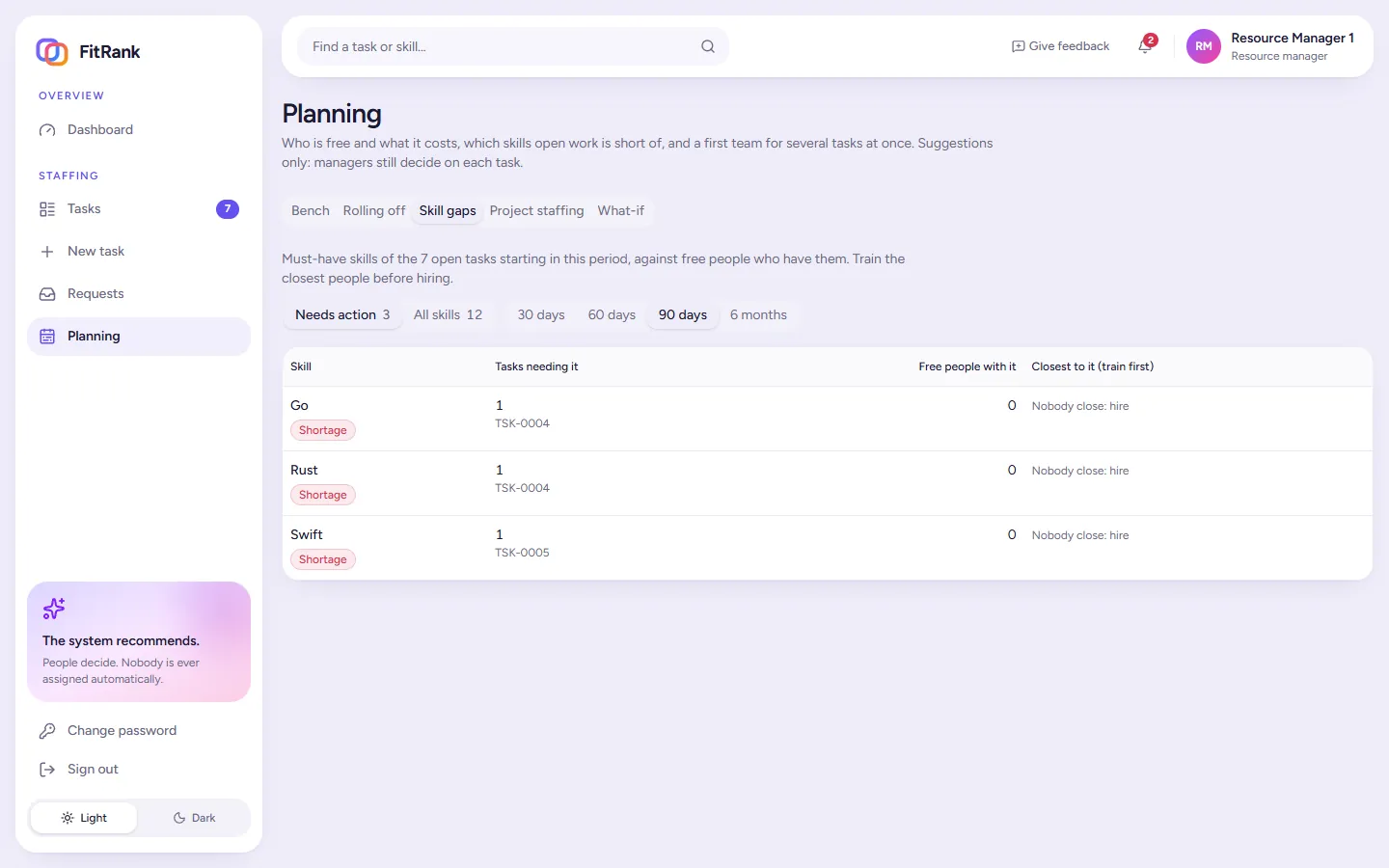 Skill gaps: train, move or hireFitRank marks every must-have skill in upcoming work as shortage, tight or covered, and compares the best internal person with the best outside candidate.
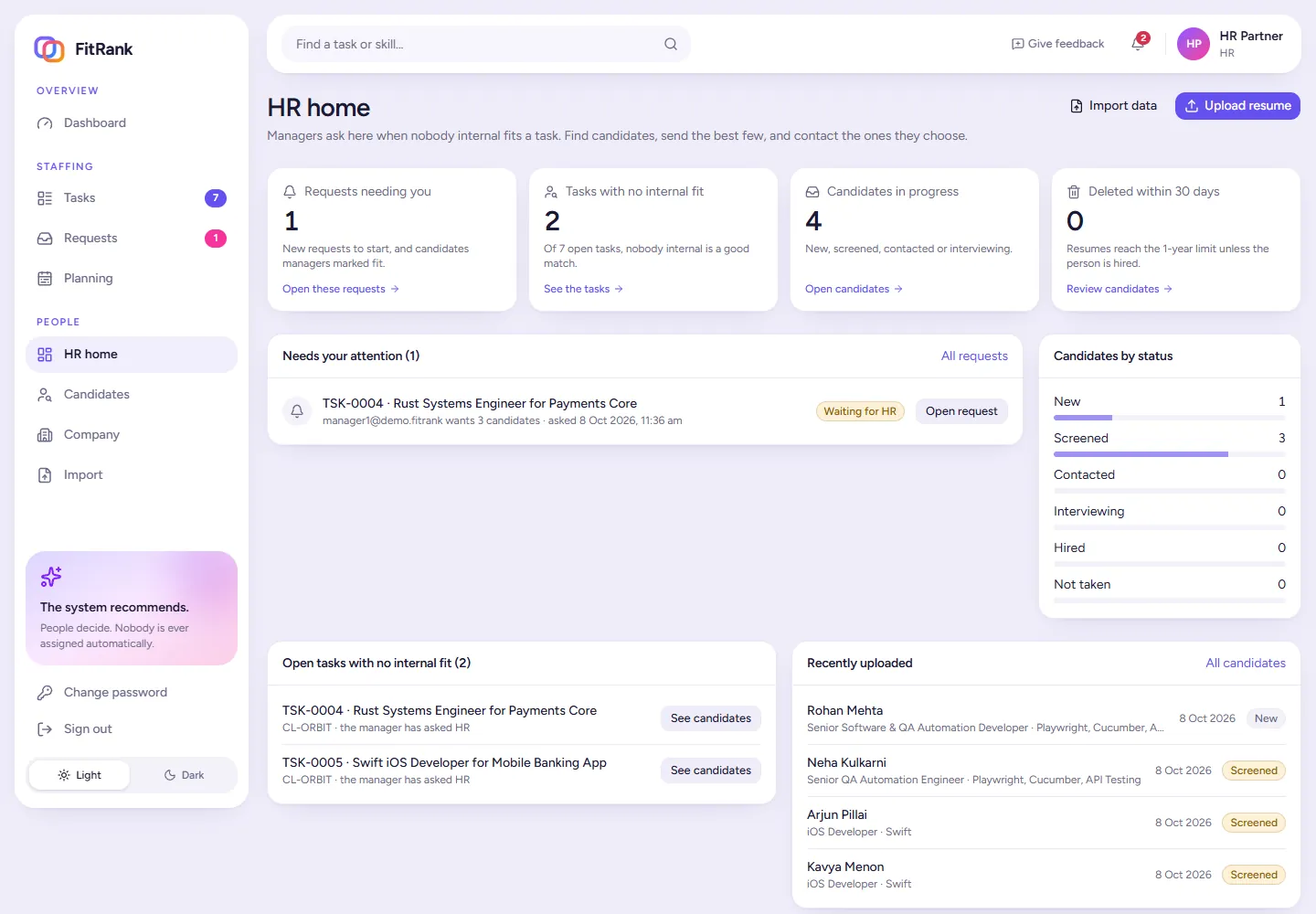 Hiring requests and candidate matchingManagers send HR a request from a task with no internal fit. HR tracks every candidate, scored against open tasks with the same rules as employees.
More use cases
Be one of the first teams to staff with FitRank
We're taking on a small number of pilot companies. Pre-register for early access, or talk to us about an annual licence.