For hr and talent acquisition teams
Hiring request to HR when no one inside fits
A clean hand-off from manager to HR: structured request, resumes read with personal details removed, candidates scored, fit recorded.

Short answer. When nobody inside fits a task, the clean way to hire is a written request from the manager to HR that carries the task's skills, level and dates, followed by resumes read with personal details removed, candidates scored against the task, and a recorded fit or not-fit from the manager. FitRank tracks that whole loop in one place.
Why the hand-off breaks
A resource manager runs out of internal options and sends HR an email: we need a data engineer, can you find someone? The email says little about level, start date or client domain, because those live in the task, not in the email. HR replies with questions, then screens resumes by hand against one role at a time, and the manager hears back days later with a list nobody can compare against the task.
Three things go wrong. Detail is lost between the task and the request. Nobody can see where a request stands. And resumes, which are full of personal information, are handled casually: photos, dates of birth and addresses travel by email and sit in inboxes.
An illustrative example: one request, three candidates
The task, the candidates and the dates below are invented.
A manager has a task for a senior QA engineer starting 12 January. No one inside covers the test automation must-have. He asks HR for up to three candidates directly from the task. HR sees the request with the skills, level, dates and the manager's note, so there are no clarifying emails. HR uploads three resumes. Each is stripped of name, contacts and photo before a model reads it, and the extracted fields are checked by an HR person before they are saved.
Two candidates cover the must-haves. One has a notice period that ends on 20 January, so the blocker reads as a date clash of eight days, in plain words. The manager marks the first as a fit and the second as a fit with a later start, and the third as not a fit because of the domain. The request closes with a record of all three decisions.
A hand-off you can run without software
- Send requests as structured information, not a sentence: skills, level, start date, location, how many candidates and a note on what matters most.
- Give HR one place to see every open request and where each stands.
- Remove personal details from a resume before anyone, or any tool, evaluates it. Judge the professional part: experience, skills, domains.
- Record what the resume does not state, such as notice period, as unconfirmed rather than guessing it.
- Score every candidate against the task on the same rules as employees, and write blockers as dates a person can check.
- Close the loop: the manager records fit or not-fit for each candidate.
- Set a retention rule for candidate files and keep to it.
How FitRank handles it
- Request. From a task with no internal fit, the manager asks HR for one to ten candidates. See HR home and hiring requests.
- One page for HR. HR home lists open requests, tasks nobody inside can take, the candidate pipeline and files due for deletion.
- Reading. HR uploads a PDF or Word resume and records where it came from. Code removes names, emails, phone numbers, addresses, links, dates of birth and photos first. The AI then fills professional fields only, and anything not stated is marked unconfirmed. HR checks every field before saving. See privacy-first resume reading.
- Scoring. Candidates are scored with the same rules and facts as employees, and blockers read like a date clash in words. A task shows its candidates ranked, and a candidate shows every open task they fit. HR can also put a candidate forward to a manager without waiting to be asked. See two-way candidate matching.
- Contact details. These stay with HR. The manager sees the profile and the fit, and HR contacts the people they choose.
- Consent and retention. Candidate consent is recorded, and files are deleted after a year unless the person is hired.
Why the stripping step matters is covered in removing personal data before AI; in short, the model never receives the part of a resume that identifies a person, so it cannot use it.
A checklist for the HR side
- Every request has skills, level, dates and a named manager.
- Every resume source is recorded.
- Personal details are removed before any evaluation, human or automated.
- Unstated fields are marked unconfirmed.
- Notice period is turned into an earliest start date, and compared with the task date. The notice period calculator helps with the date arithmetic.
- Consent is recorded and a deletion date exists.
- The manager's verdict on each candidate is captured, with a reason.
Common mistakes
- Screening against the job title instead of the task's skills.
- Accepting whatever a parser returns as fact. A guessed notice period is worse than a blank one.
- Letting managers see contact details, which invites side conversations and breaks the process.
- Keeping candidate files forever. Without a retention rule, a resume database becomes a liability.
- Never looking at candidates against other open tasks. The person who misses one task may fit another.
When FitRank is not the right tool
FitRank is not a full applicant tracking system: it does not post jobs, run career pages, schedule interviews or send offers. Bulk resume upload is on the roadmap but not built, so resumes go in one at a time. It reads PDF and Word files. And it supports hiring for tasks that already exist in the system; if you hire for general headcount with no task attached, a conventional ATS fits better.
Questions people ask
Is the resume sent to an AI service with the candidate's name?
No. Names, contact details, links, dates of birth and photos are removed by code first. The AI only sees the professional part.
What if the resume does not state a notice period?
The field is marked unconfirmed for HR to fill in. FitRank never fills it with a guess.
How many candidates can a manager ask for?
Between one and ten per request.
Do managers see candidates' contact details?
No. Contact details are for HR only.
How long are candidate files kept?
One year after upload, then they are deleted automatically, unless the candidate is hired.
The features that do the work
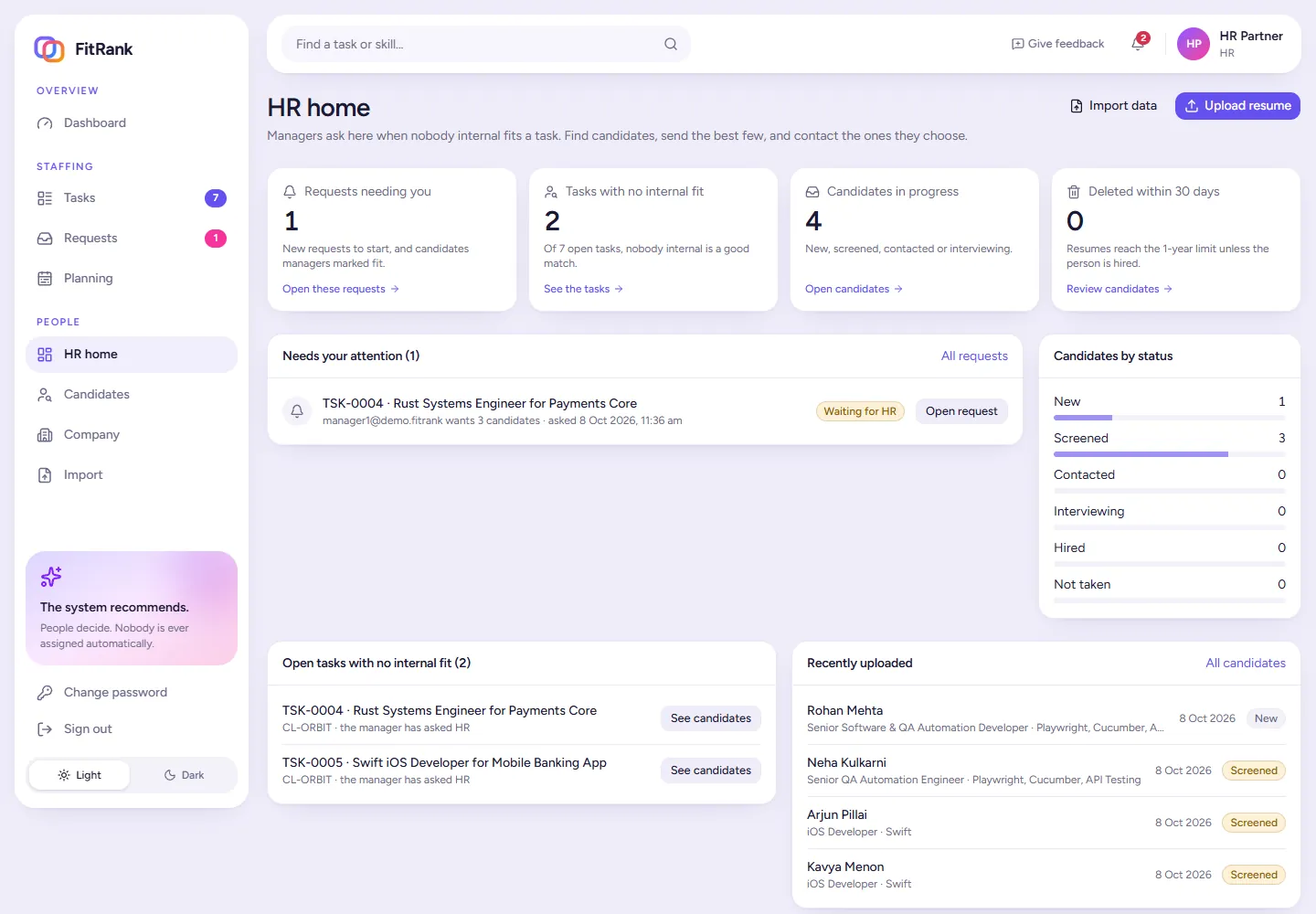 Hiring requests and candidate matchingManagers send HR a request from a task with no internal fit. HR tracks every candidate, scored against open tasks with the same rules as employees.
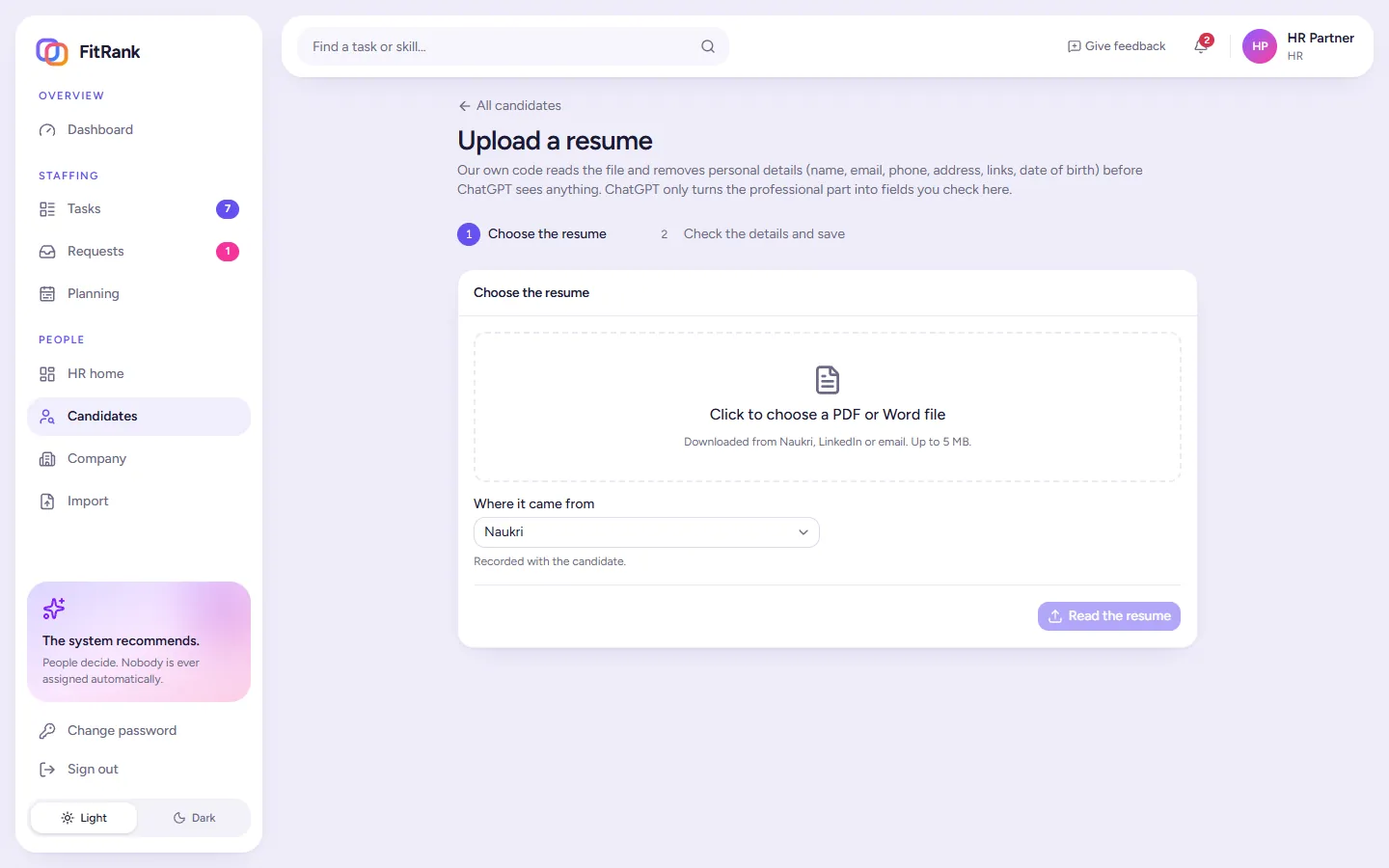 Privacy-first resume readingUpload a PDF or Word resume. Code removes names, contacts and personal attributes before AI reads it, and HR checks every field before it is saved.
More use cases
Be one of the first teams to staff with FitRank
We're taking on a small number of pilot companies. Pre-register for early access, or talk to us about an annual licence.