For resource management offices
Staffing several tasks at once without double-booking
Staffing tasks one at a time gives the best person to the loudest task. Plan the portfolio together, without booking anyone twice.

Short answer. To staff several tasks at once, take the best candidates for every task together and assign each person to at most one of them within the time they actually have free, instead of letting each task pick its favourite in turn. FitRank proposes a plan for up to 30 tasks that never books anyone twice and shows the margin of each proposal; managers still decide task by task.
The problem: the loudest task takes the best person
When tasks are staffed one at a time, the order decides the outcome. The task that was raised first picks the strongest person, and the next task gets the strongest of whoever is left. That is not necessarily the best way to staff the portfolio. The second task might have needed that person far more than the first, who would have been just as happy with a close second choice.
Resource management offices see this at the start of a quarter, when several tasks start together, and in a rush before a client review, when everyone asks for the same three people. The plan that looks best task by task is often not the best for the project.
An illustrative example: three tasks, two good people
These tasks and people are invented to show the effect.
Three tasks start in the same month: a cloud migration, a reporting rebuild and a test automation task. Two people, Asha and Ravi, are strong on the cloud task. Asha is also the only person who fits the reporting rebuild well. Ravi is a decent fit for test automation. One at a time, the cloud task goes first and picks Asha, because she scores highest. The reporting task is left without a strong candidate, and Ravi, now free, ends up on test automation, where he is only a decent fit.
Looked at together, the better plan is Ravi on the cloud task, Asha on the reporting rebuild, and a person who fits test automation well on that task. The cloud task has a slightly weaker lead and the other two are well covered. That kind of trade-off is invisible when the tasks are decided in isolation.
A way to plan a portfolio without software
- List every task that starts in the window, with its must-have skills and dates.
- For each task, write down the three best people from a proper match, not the first three you thought of.
- Look for people who appear on more than one task. These are the contested people.
- For each contested person, ask where their absence hurts least and where it hurts most.
- Assign contested people first, then fill the rest with their next best.
- Never book anyone beyond the time they have free. A person at 150 per cent is a plan that fails in week two.
- Compare the plan with the one-by-one version. If they are the same, you lose nothing; if they differ, you have found the problem.
How FitRank handles it
- Choose the tasks of one project, up to 30, each with a finished matching run. If a task has no run yet, FitRank says so and offers to run matching, so the plan is always built from scored results.
- FitRank proposes one person per task. It never proposes the same person twice, and never beyond the time they have free.
- Each proposal shows the person's band and fit, the alternatives, and the margin of that choice. The plan as a whole shows tasks filled and gross margin per week. See staff several tasks at once.
- It is a proposal. The manager of each task still decides on the matching results, and nothing is assigned automatically.
The matching results come from the same rules, facts and five judgements as a single-task match, so the plan inherits their reasons. See how a recommendation is made for that pipeline.
A checklist for a multi-task plan
- Every task in the plan has a recent match, so the plan is built from the same data.
- Nobody appears twice, and nobody is booked past their free time.
- Contested people are identified and discussed before tasks are confirmed.
- Each task has an alternative if its first choice declines.
- Margin is compared across plans, not just for one task.
- The plan is reviewed again when a start date changes, because it changes who is free.
Common mistakes
- Staffing in the order tasks were raised, which rewards the loudest rather than the most important.
- Booking someone at full time on two tasks because both start in the same week.
- Optimising only margin. A cheap plan filled with people at Review is a risky plan.
- Planning from stale matches. If the task changed after the run, the proposal reflects the old version.
- Forgetting the bench. The people free in the next month are often the best fix for a contested task. See cutting bench time.
When FitRank is not the right tool
The plan handles up to 30 tasks and works from finished matching runs, so it is for a project or a portfolio of real tasks, not for hundreds of roles at once. It proposes people; it does not negotiate between managers, move people between projects, or know about informal commitments. If you have two tasks and one obvious person each, you do not need a plan. If your problem is shift cover over a week, a rota tool such as the schedule generator is closer to what you need.
Questions people ask
Does the plan assign the people?
No. It is a proposal. Each task is still decided by its manager on the matching results.
What if a task has no matching run yet?
FitRank says so and offers to run matching for it, so the plan is always built from scored results.
How many tasks can I plan at once?
Up to 30 tasks that each have a finished matching run.
Can the same person be proposed twice?
No. One person per task, never beyond the time they have free.
What does the plan show about money?
Each proposal shows its margin, and the plan shows tasks filled and gross margin per week, worked out from your rate card.
The features that do the work
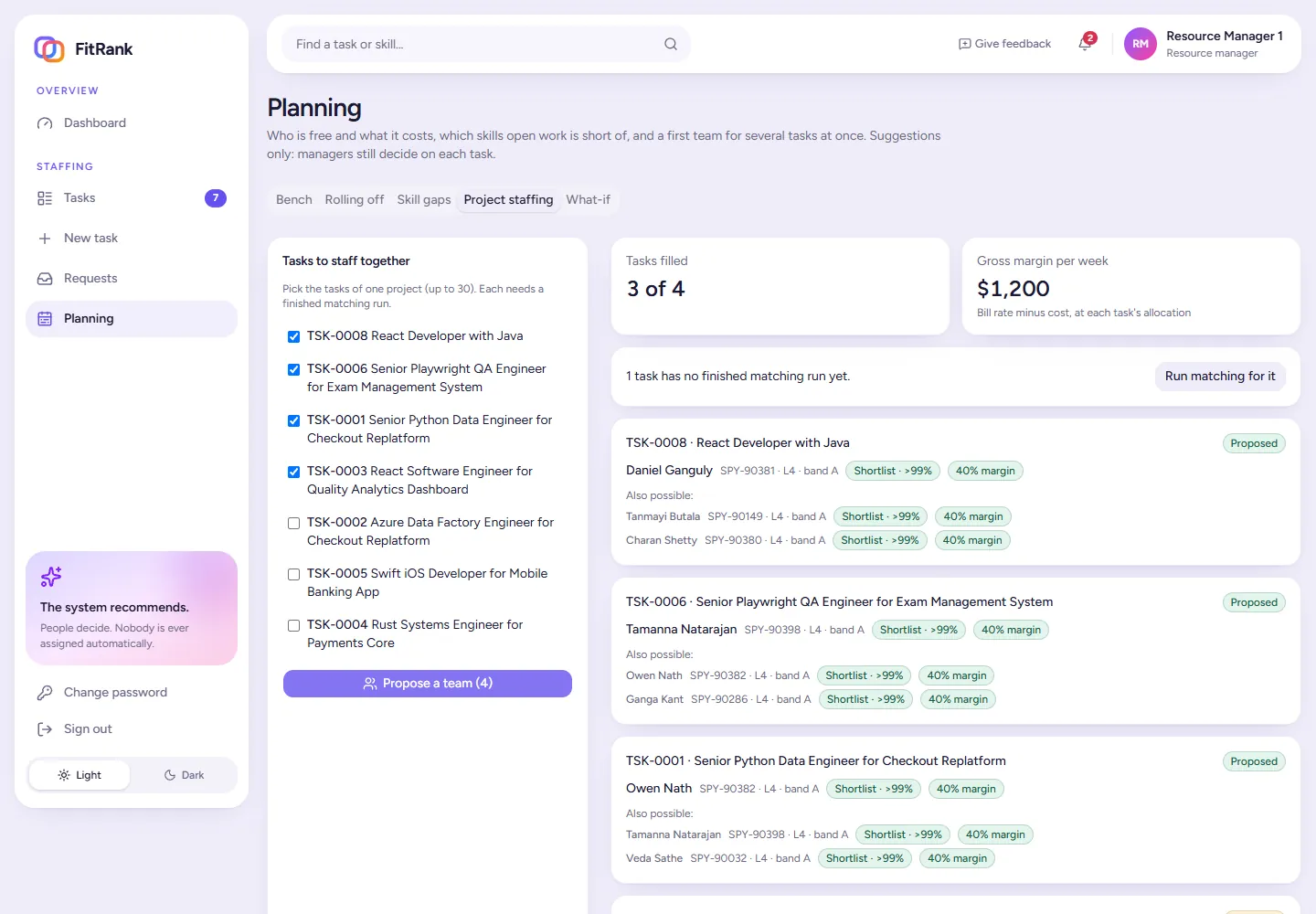 Staff several tasks at oncePick the tasks of one project and FitRank proposes one person per task from finished matching runs, with alternatives and the margin of each plan.
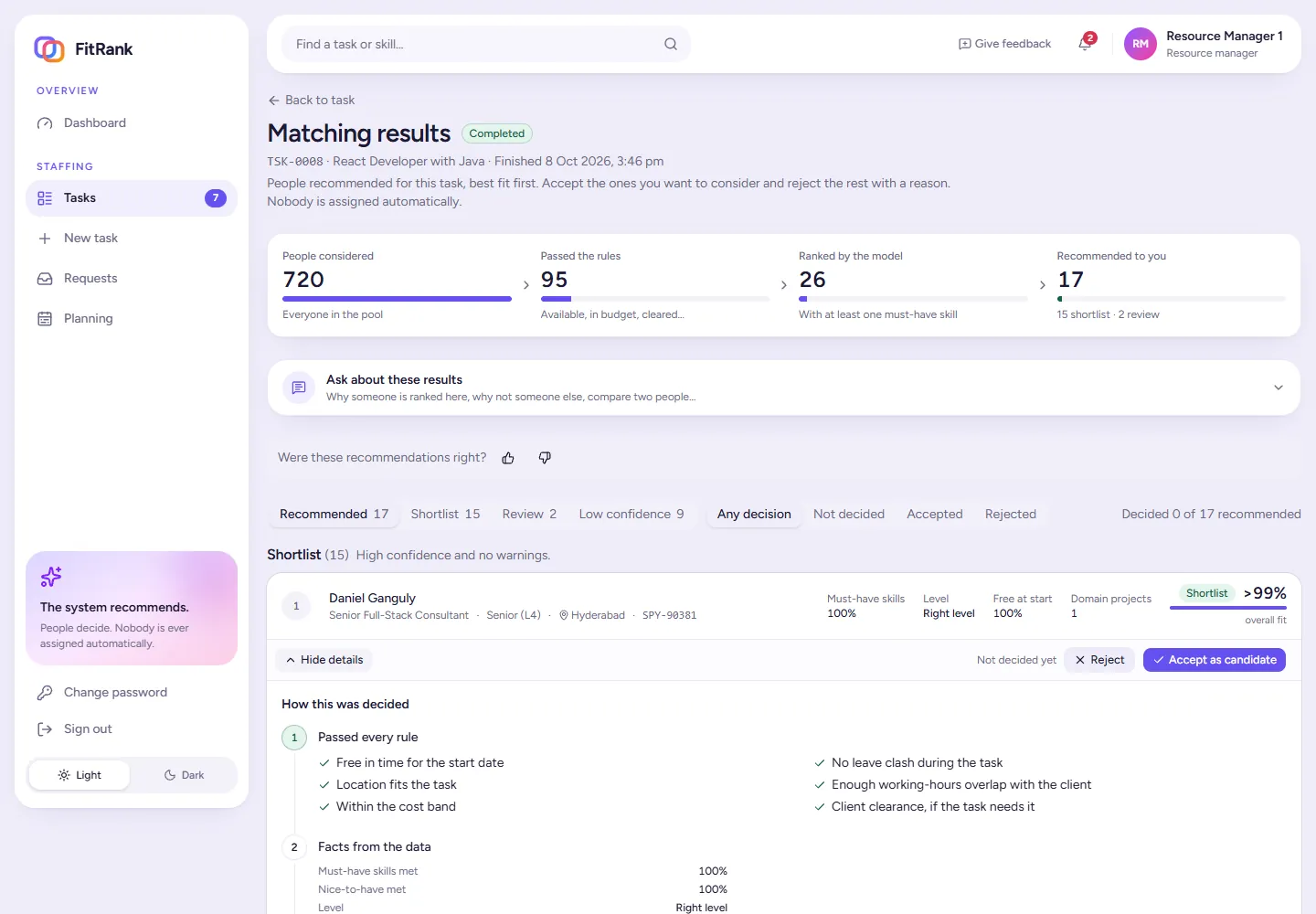 Explained matching and shortlistsOne click ranks everyone who can take a task. Each person shows the rules they passed, the facts, the model's probabilities and the band they landed in.
More use cases
Be one of the first teams to staff with FitRank
We're taking on a small number of pilot companies. Pre-register for early access, or talk to us about an annual licence.