For pre-sales and account teams
Can we staff this deal? Check before you sign
Check a prospective deal against the real bench before you promise a start date: roles, skills, who is free in time, and margin per week.

Short answer. Before you promise a start date on a deal, check it against the people you really have: list the roles, levels, must-have skills and the date, then see who would be free and qualified by then and what the work would earn per week. FitRank's what-if check does this with rules only, in seconds, and creates nothing, so you can test as many versions of the deal as you like.
The promise made before anyone checked
Pre-sales and account teams are rewarded for closing, so a start date often gets agreed in the room: we can begin in six weeks. Delivery learns of it afterwards. If the bench cannot cover the roles by then, the options are a rushed hire, a late start, or borrowing people from other work. All three cost more than the check that would have prevented them.
The check is not complicated in principle. It is hard in practice because the information sits with resource managers, in a sheet or in their heads, and asking them takes a day. So the question gets skipped, or answered with optimism.
An illustrative example: a four-role proposal
The deal and the numbers are invented. No real client or company is described.
A prospect wants a team for a data platform project starting in six weeks and running for five months: one architect, two senior engineers and one tester. The account lead describes the roles: level, the highest cost band the deal can carry, and the must-have skills for each. The check returns that three of the four roles can be staffed from inside by the start date, with named people free in time. The architect role has nobody free and qualified until three weeks after the start.
Now the account lead has useful choices. She can propose a start date three weeks later, or open the deal with a plan to hire an architect now, or bring in a contractor for the first month. She also has the weekly billing and margin of the three staffed roles. She has made no promise yet, and nobody was reserved or alarmed by her question.
A pre-sales check you can do by hand
- Write the deal as roles, not as a headcount: for each, the level, the must-have skills, how many people and the highest cost you can carry.
- Fix the start date and the length. A role that is free for three of five months is not free.
- For each role, find who is free by the start date. Use end dates of current allocations, not hopes.
- Keep only people who meet the must-have skills and level.
- Count roles you can fill, and note the first date you could fill the rest.
- Work out billing and margin per week from your rate card, so the commercial side sees the effect of staffing choices.
- Rerun it for a different start date. The date is the cheapest lever you have.
How FitRank handles it
- You enter the start date, the length, and for each role the number of people, level, highest cost band and must-have skills.
- FitRank checks who would be free and qualified in time, using rules only. That makes the answer instant and repeatable, which is what a what-if needs. The model's ranking is kept for real tasks, where a manager reviews it.
- The result shows how many roles you can staff from inside, the people who could fill them, and billing and margin per week.
- Nothing is created or reserved. No task is added and nobody is held, so you can try as many scenarios as you like. When the deal is won, you create the real task and run matching. See what-if staffing for pre-sales.
- For the margin, FitRank uses your rate card and margin target; salaries are not stored. See employee value and client profiles.
A what-if tells you whether a role could be staffed, not who is best for it. That needs a real task and a match run. The step from one to the other is described in how to find the right person for an open task.
A checklist before you commit a date
- Each role is written with level, must-have skills, count and cost ceiling.
- Start date and length are stated, and checked against end dates of current work.
- Roles that cannot be filled from inside have a plan and a date: hire, contractor or later start.
- Margin per week has been looked at by someone who owns the price.
- A second scenario was tried with a different start date.
- Delivery was told about the possible deal before the date was agreed.
Common mistakes
- Checking headcount, not roles. Ten free people do not help if none has the skill.
- Assuming people on notice or rolling off will be free. Use the dates in the system.
- Reserving people for a deal that may not close. Holds become bench in disguise.
- Forgetting the cost ceiling. A role you can fill only by an expensive person may not be worth taking.
- Treating one yes as final. If the deal changes shape, run the check again.
When FitRank is not the right tool
The what-if uses rules only, so it says who could be available and qualified, not how well each person would do. It checks who is free and qualified inside the company, so it will not tell you what a contractor or outside hire could cover. It reads availability from allocations in the system, so it is only as accurate as those are. If you bid on very large programmes, a capacity-planning tool built for forecasting hundreds of roles over years is a better fit. For a first sense of what your skills inventory looks like, the skill matrix template is a free start.
Questions people ask
Does a what-if check reserve people?
No. It creates no task and holds nobody. Run matching on a real task when the deal is won.
Why rules only?
A what-if check needs to be instant and repeatable. The model's ranking runs on real tasks, where a manager reviews it.
What do I need to enter?
The start date, the length, and for each role the number of people, level, highest cost band and must-have skills.
What does the result show?
How many roles you can staff from inside, the people who could fill them, and billing and margin per week.
Does it use salaries?
No. Margin comes from your rate card by cost band. Salaries are never stored.
The features that do the work
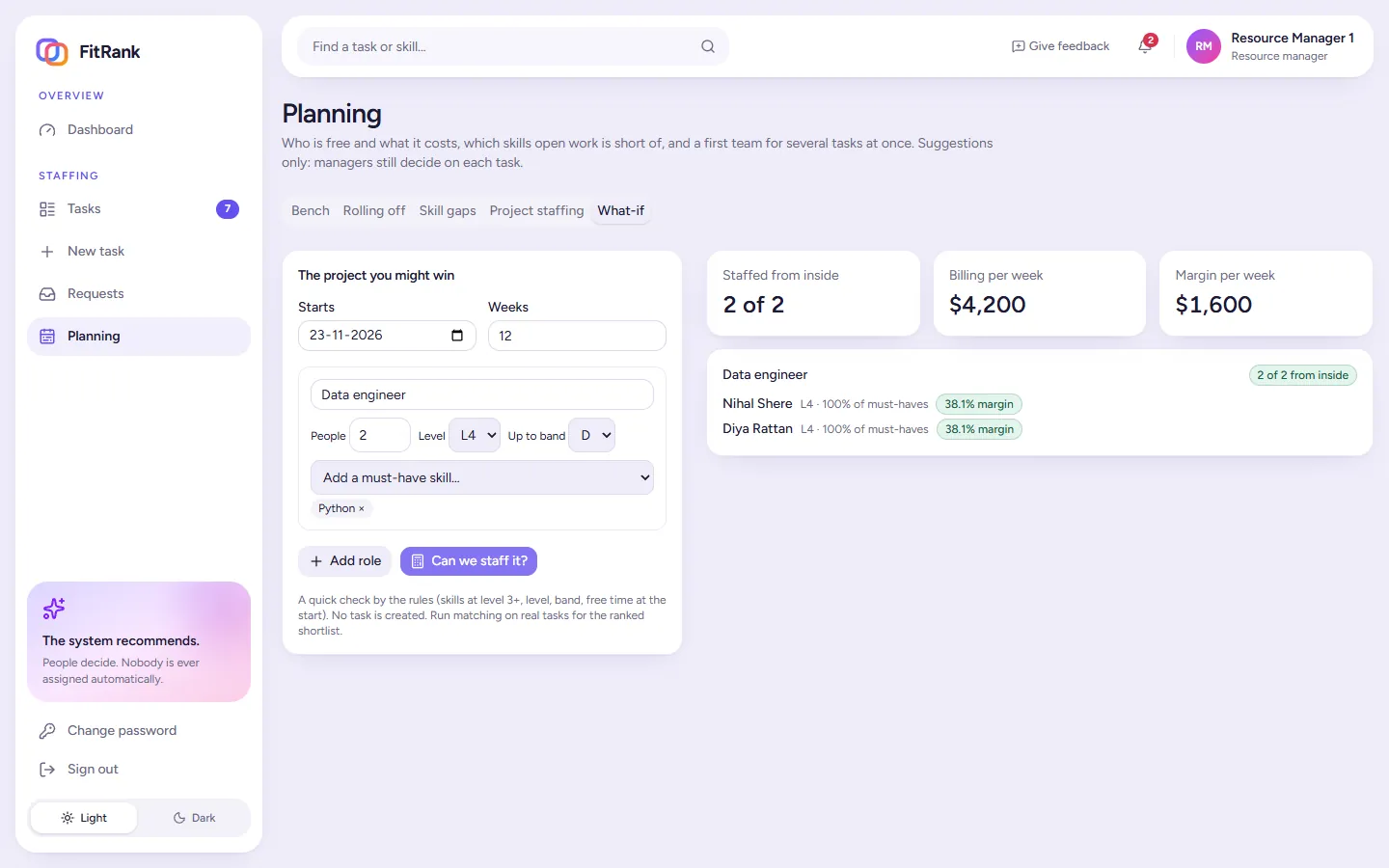 Pre-sales: what-if staffing and client profilesTest a prospective project against the real bench, with billing and margin per week, then send each proposed person's client profile. No task is created.
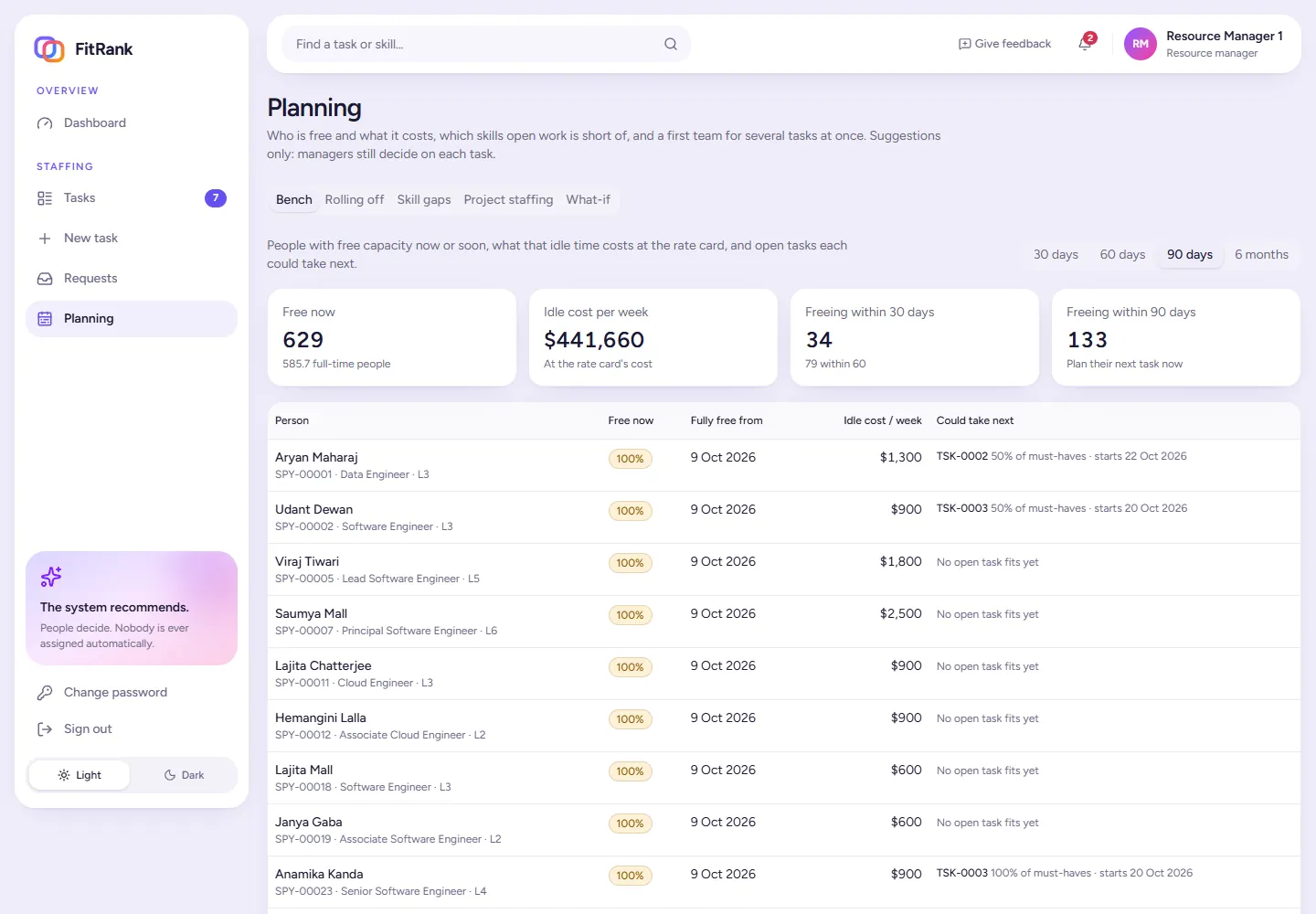 Bench and roll-offsSee who is free now or within 30, 60 or 90 days, the weekly idle cost, and the open tasks each person could take next, with roll-off warnings.
More use cases
Be one of the first teams to staff with FitRank
We're taking on a small number of pilot companies. Pre-register for early access, or talk to us about an annual licence.