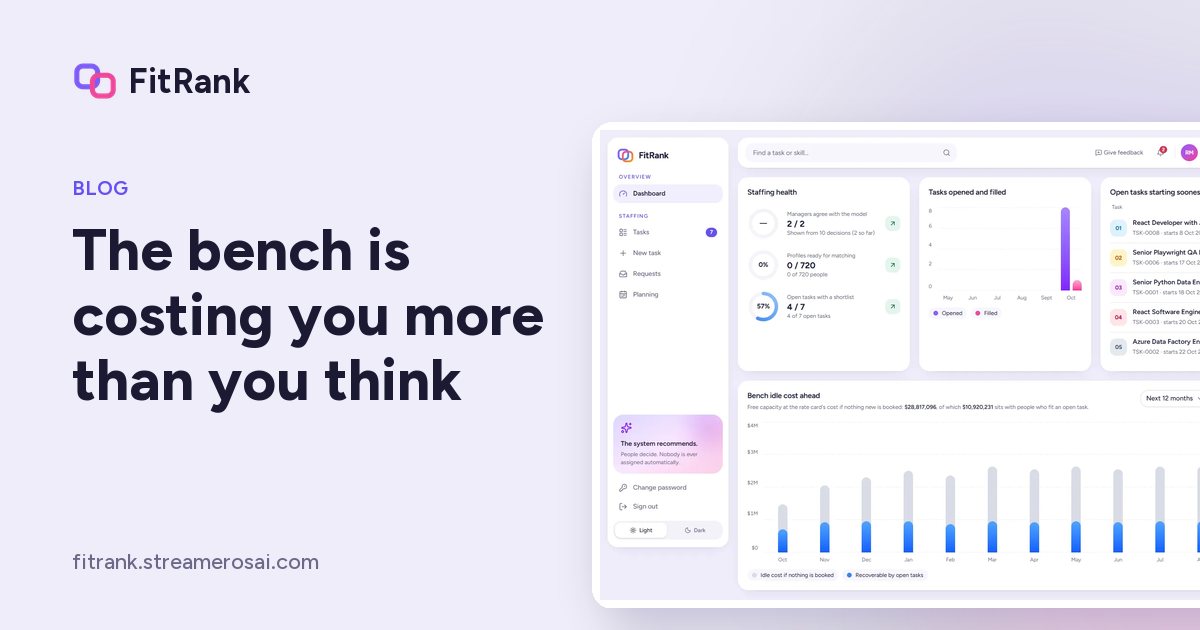
If you have worked in an IT services company, you know the Monday call. The RMG team shares a sheet, somebody reads out the names on the bench, and every manager says the same thing: nobody on this list fits my project. Two weeks later the same names are still on the sheet.
Bench is normal. Projects end, new ones have not started, people finish one engagement before the next is signed. A small bench is even healthy because it lets you say yes to a client quickly. The problem starts when people stay there and nobody can say why.
What bench management means
Bench management is how a services company handles people who are employed but not on a billable project: tracking who is free, planning when people will roll off, and moving them to the next project, to training or to internal work. In HR terms it sits between resource management, which decides who works where, and talent management, which decides how people grow.
Who handles bench management: roles and responsibilities
- Resource manager or RMG team: keeps the bench list current, matches people to open requests and reports bench cost.
- Delivery and project managers: release people on time and say early when a project is ending.
- HR: runs training plans and internal moves, and handles exits when nothing else works.
- Leadership: sets the target bench size and decides when to hire and when to redeploy.
What the bench actually costs
Take a simple example. Say 30 engineers are on the bench and the average cost to the company is ₹1 lakh a month each. That is ₹30 lakh a month going out with nothing billed against it. If even ten of them could have moved to an open task two weeks earlier, that is ₹5 lakh saved in one month, without hiring anyone or winning a new deal. Your numbers will be different, but the math works the same way for every services company.
And money is only half of it. People who sit on the bench for long start looking outside. The good ones leave first, because they get calls from recruiters every week.
Why bench management is so hard to fix
- The data is scattered. Skills are in the HRMS (often years old), availability is in a project tracker, and who is rolling off next month lives in a manager's head.
- Nobody sees the next 30 days. Most companies look at who is on the bench today, not who will be there in three weeks. By the time someone shows up on the sheet, the open tasks that fit them are already gone.
- Matching is done by memory. A manager asks around, a few names come up, and the person who is actually the best fit is never mentioned because nobody remembered them.
- There is no clear next step. Even when you know someone is free, the question is what now: propose them for an open task, train them on a missing skill, or lend them to another unit.
None of these is a hard technical problem on its own. It is hard because all of them have to be solved together, every week, while delivery keeps running.
What usually gets tried
A bigger Excel sheet. A resource management module inside the HRMS that nobody updates. A weekly review meeting. These help a little, but they all depend on someone remembering to update data and someone else remembering to look at it. Utilization dashboards tell you the bench is high. They do not tell you who should go where.
If you are comparing bench management tools or bench management software, check three things: does it show who frees up in the next 30 days, does it suggest a next step for each person, and does it explain why.
How FitRank approaches it
We built FitRank around one question for every person on the bench: what is the one next step for this person this week? It shows who is free now and who frees up in the next 14 to 90 days, and for each of them it picks the best open task they fit, or the single skill they are short of for that task.
The matching runs over everyone, not just the names somebody remembers, and every suggestion comes with plain reasons: has 4 of 5 must-have skills, free from the 12th, missing Kafka. A manager still makes every call. FitRank never assigns anyone by itself.
You can see how it works on the bench management page. FitRank is in pilot right now, so if bench time is a problem you are dealing with, we would like to hear how your team handles it today: pre-register here.
More from the blog
Be one of the first teams to staff with FitRank
We're taking on a small number of pilot companies. Pre-register for early access, or talk to us about an annual licence.