Skills gap analysis
You find out about a skill gap when the project is already late
By Yaseen Khatib, , 3 min read
A new project kicks off in two weeks and needs Kafka. Delivery asks RMG, RMG checks, and there is exactly one person with real Kafka experience, already on another critical project. Now it is a scramble: hire in a hurry, borrow from another account, or start the project and hope.
The thing is, this was visible a month ago. The deal was in the pipeline, the skill was in the JD, and the company knew how many people had Kafka. Nobody put those three things together.
Why skill gaps are found late
- The skills inventory is out of date. People fill their profile once when they join. After that it ages quietly.
- Demand is spread across places. Open tasks are in one system, upcoming deals in the sales CRM, and nobody adds them up by skill.
- Capacity planning is done in headcount, not skills. "We need 20 more people in Q1" does not tell you that 6 of them need Spark.
- Key-person risk is invisible until it hurts. When one person holds a skill that two running projects depend on, it is fine until they resign or fall sick.
A simple skill gap analysis template
- Demand by skill: open tasks plus pipeline deals likely to close, by month.
- Supply by skill: people who have it at the needed level and used it recently.
- Gap = demand minus supply, per skill and month.
- One action per gap: train someone close, move someone from another unit, or hire.
- Review it every two weeks; demand changes faster than people expect.
Key-person risk: a check you can run this week
You do not need software for a first look. List the projects running now and, for each, the skills it cannot do without. Then count how many people hold each skill at a level where they could carry it alone:
- One holder on a live project: a key-person risk. If that person resigns or falls sick, the project stalls.
- One holder across the whole company: a bigger risk, because there is nobody to borrow from another account.
- Two or three holders who are all fully booked: the skill is covered on paper and short in practice.
For each risk, pick one action: pair a second person with the holder, write down what only that person knows, or plan training for the closest colleague. Re-run the count when a project starts or ends.
What usually gets tried
Skills gap analysis software in HR suites often works on job families and competency frameworks. That is useful for career planning, but it is too slow and too general for a delivery manager who needs to know who can do Kafka next month.
How FitRank approaches it
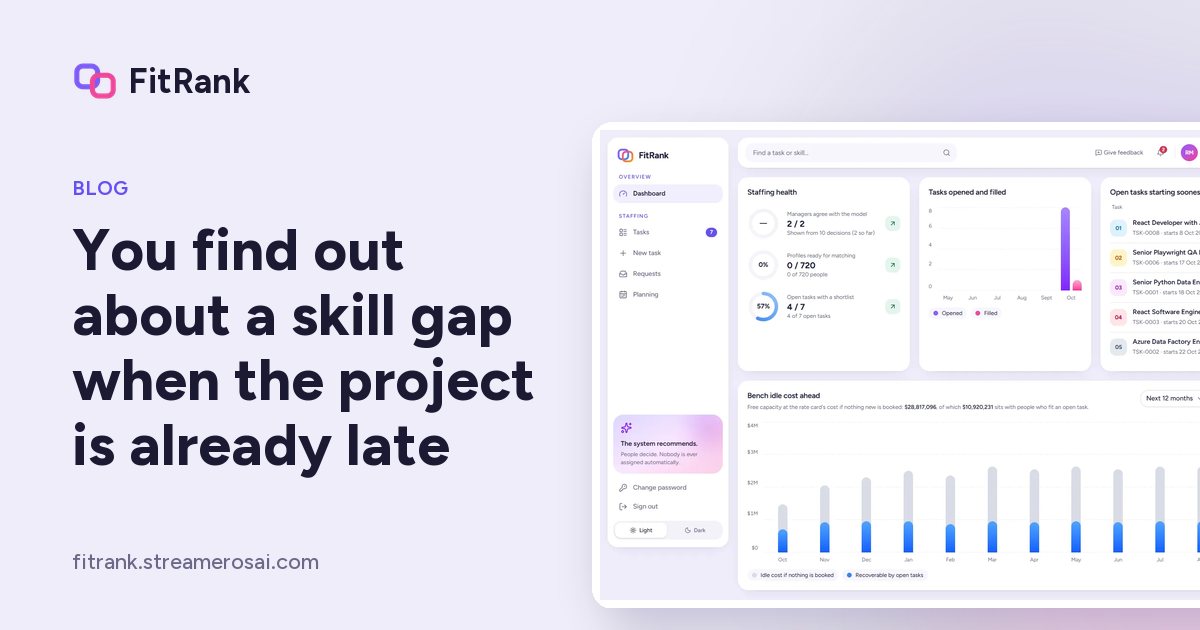
FitRank works from the same data it uses for matching. For a window you choose (30, 60 or 90 days, or six months), it reads the must-have skills of upcoming tasks and marks each one shortage, tight or covered against the people who will be free in time. For every gap it shows the free people who already have the skill and the person closest to it, so you can train before you hire.
The result is only as good as the profiles. Each skill on a profile carries a level, years of experience and when it was last used; a data-health view lists profiles that are missing information or due for their six-monthly review, and HR can check skills against a resume. When nobody is close, each open task's hire-or-move card compares the best internal person with the best outside candidate.
Details on the skill gaps and hire-or-move page. This is workforce planning for IT services at the level a delivery manager can act on this week.
More from the blog
Be one of the first teams to staff with FitRank
We're taking on a small number of pilot companies. Pre-register for early access, or talk to us about an annual licence.