Resource allocation
Why finding the right person for a project still takes days
By Yaseen Khatib, , 3 min read
A client asks for a senior React developer who has worked in banking, can start on the 15th and overlaps four hours with US time. The account manager forwards it to delivery, delivery forwards it to RMG, and RMG starts calling project managers. Three days later you have two names, one of them is not really senior, and the other is already promised to another project.
This is how resource allocation still works in a lot of IT services companies, including big ones. Not because people are lazy, but because finding the right person for a project is actually a hard problem.
Why it is harder than it looks
- Skills are not yes or no. Someone who did React five years ago and Angular since is not the same as someone who shipped React last month. Proficiency and how recently a skill was used matter as much as the skill itself.
- Requirements come in mixed up. Must-haves, nice-to-haves, level, domain, start date, location and timezone all arrive in one email, and half of them are only implied.
- Availability keeps moving. People roll off early, projects get extended, leave gets approved. A list that was right on Monday is wrong by Thursday.
- Close matches get missed. If you search for Azure Data Factory, you will not find the person who has done the same work in AWS Glue, even if they could pick it up in a week.
- It has to be fair. If the same five people always get the good projects, others stop growing and eventually leave.
What the current tools do
Most resource scheduling software and PSA (professional services automation) tools are really scheduling tools. They show who is booked where and let you filter by a skill tag. That works if your skill data is clean and your requirement is one keyword. It breaks when the requirement is a real client brief and the skill data is two years old.
Newer "AI resource allocation" tools mostly add a match percentage. The problem is that a percentage with no reason behind it is hard to trust, and managers fall back to calling people they know.
Turn the brief into a request that can be matched
Whatever tool you use, matching is only as good as the request. Before anyone searches, split the client's email into fixed fields and send back what is missing:
- Role and level: senior React developer, not just React.
- Must-have skills, each with the level needed. Keep this list short; every extra must-have removes people.
- Nice-to-have skills, kept apart so they rank people instead of excluding them.
- Domain: banking experience is a must-have only if the client said so.
- Start date, length and allocation, so availability can be checked against real free dates and leave.
- Location and working-hours overlap, written as hours, for example four hours with US Eastern time.
A request in this shape can be checked by a person in minutes and by software in seconds. A forwarded email cannot be checked by either.
How FitRank approaches it
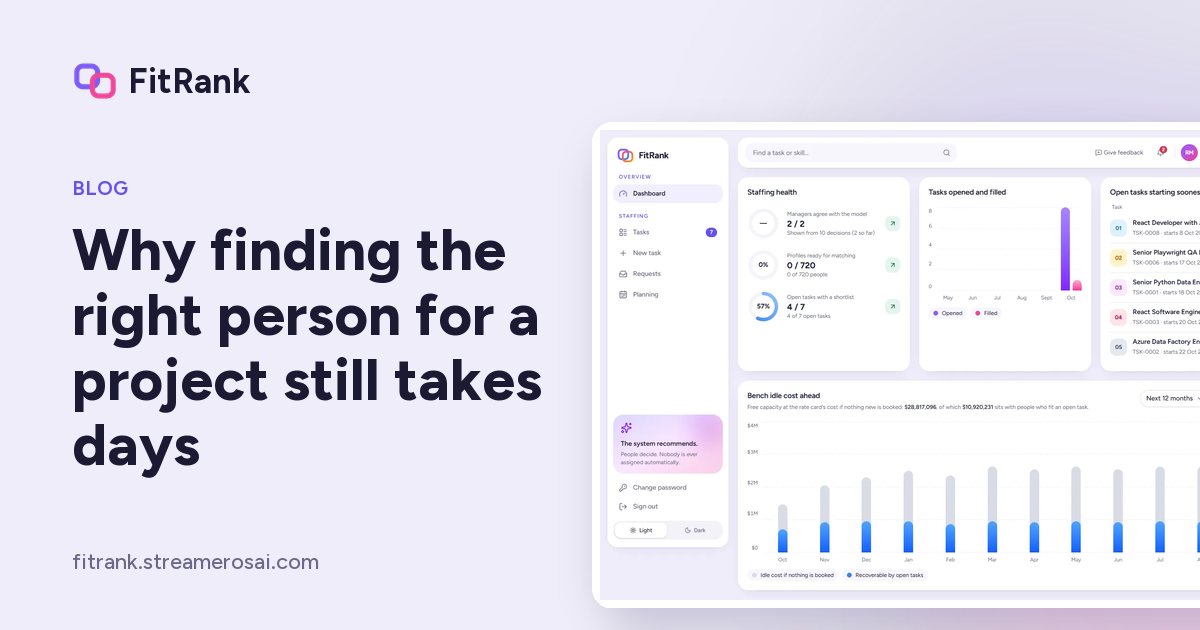
FitRank does skills-based resource matching in layers. First the hard rules run in code: available on the start date, right location or remote, enough timezone overlap. Then every person who passes is checked on five fixed questions: how well the skills match, whether the level is right, whether they know the domain, how risky delivery would be, and the overall fit. Each answer is a probability, not a guess written as text.
The result is a short list with the reasons next to every name, so a manager can see why someone is there and why someone else is not. The manager accepts or rejects, and those decisions are what the system learns from.
See how FitRank decides, plain-language task intake and explained matching for the details. It is in pilot, and we are looking for teams who want to try it on real open tasks.
More from the blog
Be one of the first teams to staff with FitRank
We're taking on a small number of pilot companies. Pre-register for early access, or talk to us about an annual licence.