Scheduling basics
Staffing vs scheduling: what each word means and which software you need
By Yaseen Khatib, , 4 min read
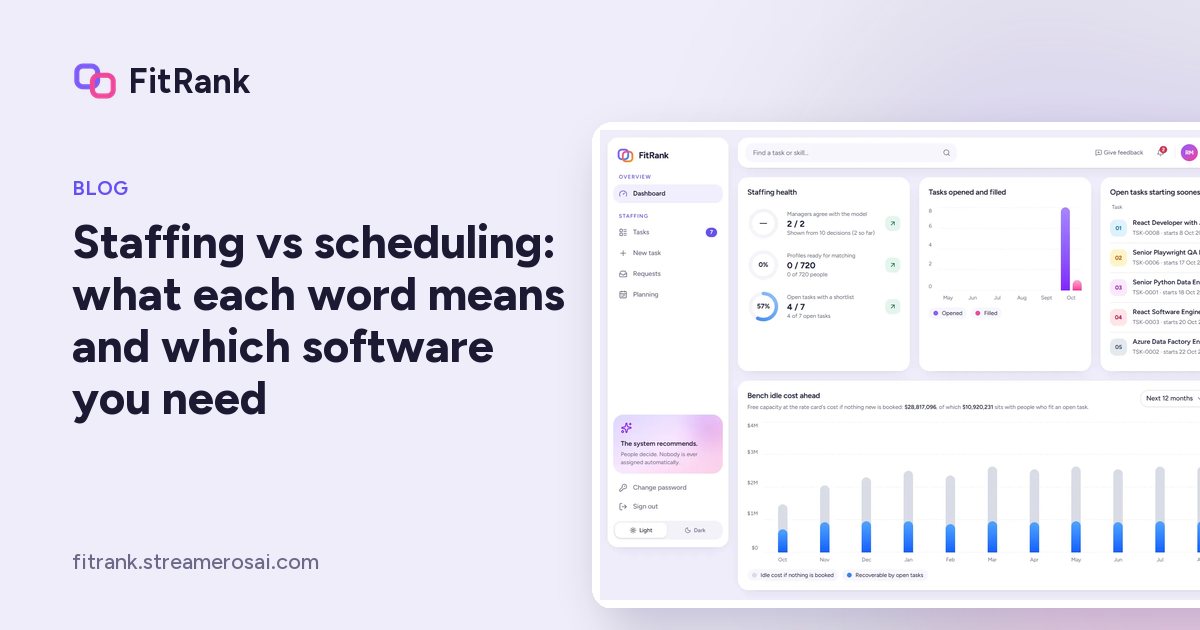
Staffing and scheduling are said in the same breath so often that they blur into one job. They are two jobs, done by different people, usually with different software, and getting the word right changes what you find when you go looking for a tool. Here is what each means, where they overlap, and how to choose.
What staffing means
Staffing is having the right number of people with the right skills in the right roles. In management textbooks it is one of the classic functions of management, next to planning and organising, and it covers workforce planning, recruiting, hiring, onboarding and keeping people. Outside the textbook the word has narrowed: a staffing agency is a recruiter, a staffing request is a hiring request, and staffing software, to most people searching for it, means an applicant tracking system or an agency back office.
We learned this the slow way. For a while we described FitRank as staffing software, and when we checked what that phrase brings up in search, the results were recruiting tools. That is not wrong; it is what the word has come to mean. It just is not what we do.
What scheduling means
Scheduling is deciding who works when: which days, which shifts, which tasks, within the hours and rest rules that apply. It starts with the people you already have. In the UK, Australia, India and much of the Commonwealth the same job is called rostering, and we have a separate explainer on what rostering is. Scheduling also reaches further than rostering: appointments, projects, machines and releases are all scheduled, but only people are rostered.
Why the two get confused
Because in operations they sit next to each other. In a hospital or a call centre, staffing is the question of how many people each shift needs (the ratio, the forecast), and scheduling is the question of who fills those slots. The two words travel together, as in staffing and scheduling, and a planner does both in the same morning. In an IT services company the split is different: staffing a project means choosing which of your engineers goes on it, which is a scheduling and matching decision, not a hiring one, and that is where the vocabulary falls apart.
Four kinds of software, and the question each answers
- Recruiting software (applicant tracking systems, agency platforms): we do not have this person; find and hire them. This is what you get when you search for staffing software.
- Workforce management (forecasting and staffing levels): how many people, of which skill, does each hour or week need? Common in contact centres and retail, often bundled with the next kind.
- Employee scheduling software (rostering apps): of the people we have, who works which shift, with time off, swaps and notifications. This is what a search for staff scheduling software returns, and it is the right word for the shift grid. If you are still in Excel, read how far automated employee scheduling in Excel goes first.
- Fit ranking (resource management for project work): of the people we have, who is the right person for this task, and why? Skills, level, domain, availability and risk, with a reason you can check. This is the question FitRank is built for.
How to tell which one you need
- If the people do not exist yet, it is staffing in the hiring sense: recruiting software.
- If the people exist and the problem is coverage of hours, it is scheduling: a rostering app, or the free schedule generator and Excel template on this site while the team is small.
- If the people exist and the problem is choosing the right one for a piece of work, and defending the choice, it is fit ranking.
- If you are not sure, write the sentence you would say to a colleague. Nobody says schedule me a Java developer for this client; they say find me one. Nobody says find me someone for Tuesday night; they say who can cover it. The verb tells you the category.
Where FitRank sits
FitRank is AI staff scheduling in the fit-ranking sense: it ranks your people for an open task with rules in code, a probability for every typed answer and a reason that cites the facts, and a manager makes every final call. It does not recruit, and it is not a shift roster tool. It is in pilot with a small number of companies, built for IT services and project work. If that is your question, how FitRank decides is the place to start; if your question is a rota, the free tools above are yours to keep.
More from the blog
Be one of the first teams to staff with FitRank
We're taking on a small number of pilot companies. Pre-register for early access, or talk to us about an annual licence.