Utilization
Utilization rate vs billable utilization: what to actually track
By Yaseen Khatib, , 3 min read
Ask three people in an IT services company what the utilization is this month and you may get three numbers. Finance has one, delivery has another, and RMG has a third. Usually all three are right, because they are measuring different things.
The two numbers
- Utilization rate: hours people spent on any project work divided by the hours they were available. Internal projects, pre-sales and proofs of concept count.
- Billable utilization: hours actually billed to a client divided by available hours. Only work the client pays for counts.
A team can be 90% utilized and 60% billable. Everyone looks busy, but a third of that busy time earns nothing. That is the gap that hurts margins quietly.
The formulas, with an example
- Resource utilization % = hours on any project work ÷ available hours × 100.
- Billable utilization % = billable hours ÷ available hours × 100.
- Available hours are usually working hours minus leave and holidays, for example 8 hours × 21 working days = 168 hours in a month.
Example: someone with 168 available hours who billed 126 hours has a billable utilization of 75%. If they also spent 20 hours on an internal tool, their resource utilization is 146 ÷ 168, about 87%. Targets differ by company and role, so agree yours and write down what counts.
Because billable utilization often shows up in appraisals, people care how it is counted: whether training, bench time and internal projects count against them, and whether leave is removed from available hours first. Settle those rules once, in writing.
Decide what counts before you measure
Most arguments about utilization are arguments about the denominator. Write one line for each of these and publish it with the report:
- Leave and public holidays: removed from available hours, or counted as unavailable time? Removing them is the usual choice and the fairer one.
- Training: does approved training count as utilized time? If it does not, people avoid training when the bench is low.
- Pre-sales and proofs of concept: utilized but not billable, so they show in the first number and not the second.
- Partial allocations: someone on a project at 50% has half their available hours expected to be billable, not all of them.
- Non-billable client work: support hours the contract does not pay for are utilized time, and a reason to revisit the contract.
How the numbers mislead
- Internal work hides the bench. Parking people on an internal tool or a long proof of concept makes utilization look fine.
- Averages hide people. 80% billable across 200 people can mean most are fully billed and 30 have billed nothing for two months.
- Monthly is too late. By the time the monthly report shows a dip, the weeks are already lost.
What to track every week instead
In our view three things matter more than the headline percentage: who has billed nothing for more than two weeks (by name), who will roll off a billable project in the next 30 days, and which open tasks those people could fill. Those three lists turn a number into actions.
How FitRank approaches it
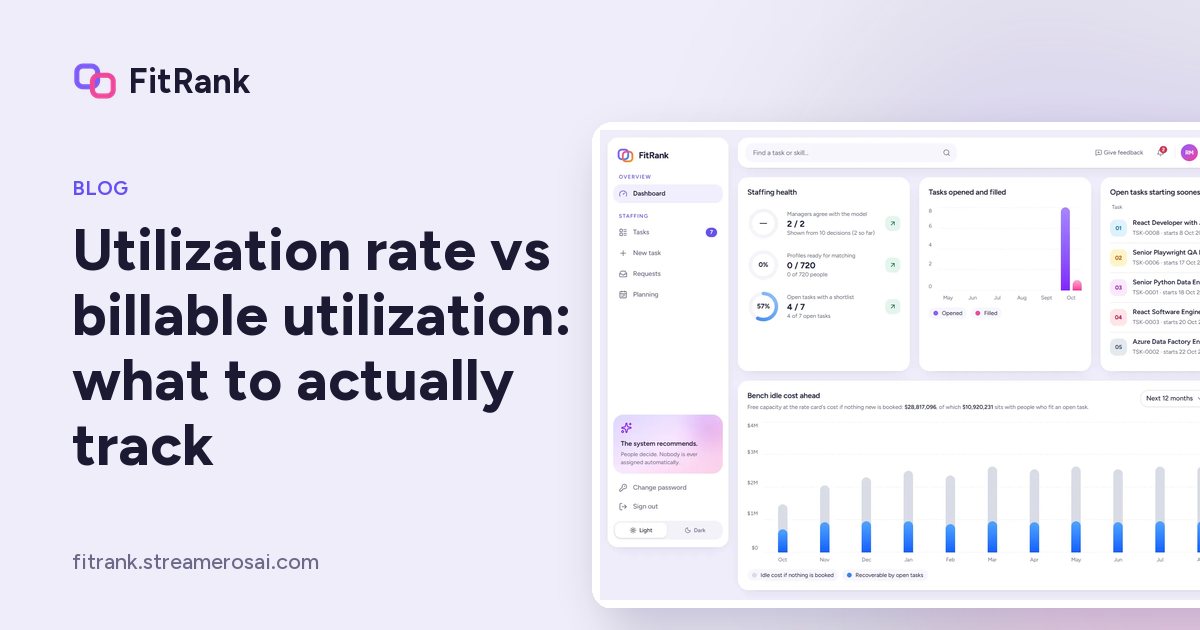
FitRank shows the bench and the people rolling off by name, with the idle cost from your rate card, and for each person the open task they fit best or the skill they are missing. The staffing dashboard also prices the next 12 months of idle time day by day if nothing new is booked. Billing figures are optional; some teams hide them on screen, and the lists still work. See the staffing dashboard.
What is a good billable utilization rate?
There is no single right number. It depends on the role, the contract type and how much time a company sets aside for training and pre-sales. Agree a target per role, write down what counts as available and billable, and watch the people furthest below it rather than the average.
Does bench time count as utilization?
No. Bench time is available time with no project work, so it lowers both numbers. If bench people are moved to internal work, resource utilization rises but billable utilization does not, which is why both should be reported.
More from the blog
Be one of the first teams to staff with FitRank
We're taking on a small number of pilot companies. Pre-register for early access, or talk to us about an annual licence.