For leadership, hr and compliance
How to audit AI staffing decisions for fairness
What to record, what to leave out and how to test recommendation rates, so AI-assisted staffing decisions can be explained to an auditor.

Short answer. To audit AI staffing decisions, you need three things on record: what the system was given and what it was never given, what it recommended and why, and what a person did with the recommendation. Then test whether qualified people in different groups are recommended at similar rates. FitRank keeps that record in an exportable audit CSV and runs the fairness test, using the four-fifths rule and a significance test.
Who asks, and why they cannot get an answer
Leadership, HR and compliance teams are the ones asked: why did the system suggest this person? Does it treat groups differently? Can we show it to an auditor, a works council or a client's procurement team? With most AI tools the honest answer is that nobody knows, because the tool returns a score and keeps nothing about how it got there.
That gap matters more for decisions about people than for most software. A hiring or staffing tool shapes who gets the interesting project, who gets seen, and who sits on the bench. Trust in such a tool has to be earned with records, not assurances.
An illustrative example: an auditor's three questions
The scenario is invented. It describes a kind of review, not a real one.
An internal auditor selects ten staffing decisions from the last quarter and asks three things for each. What information did the system use about the person? Which model produced the recommendation, and what did it say about the alternatives? What did the manager do, and why? If the answers sit in three systems and one manager's memory, the audit takes days and ends in doubt. If every recommendation is stored with its model, version, probabilities, band and the manager's action, the auditor exports one file and reads the answers.
The auditor then asks a fourth question that no single decision can answer: across everyone qualified for such work, were people in one location recommended less often than equally qualified people in another? That needs a rate comparison with enough data behind it to mean something.
A method for auditing AI-assisted decisions
- Define what must never be used. Write the list: protected characteristics, photos, anything that identifies a person in a way unrelated to work.
- Check that the list is enforced in the system, not just in policy: what is stored, what is sent to any external AI, and what is used as a signal.
- Keep a per-decision record: inputs, model and version, output, human action and time.
- Version every setting that changes outcomes, such as cut-offs and models, with who changed it and why.
- Compare recommendation rates between groups of qualified people, but only once there are enough decisions for the rate to mean something.
- Treat a flagged gap as a question for a human, not a verdict. Investigate the cause.
- Repeat on a schedule, not only after a complaint.
How FitRank handles it
- Protected attributes are never stored, sent to AI or used as signals: gender, age, religion, caste, ethnicity, nationality, marital status, disability, health, sexual orientation, political views, photos and salaries. Names and employee codes are never sent to a language model. See security and access.
- Every recommendation records the model, versions, score, band and what the manager did. All of it can be exported as an audit CSV, and sign-ins, task changes, decisions, thresholds, model switches, imports and outcomes are audited too.
- The fairness view compares recommendation rates by location and practice among qualified people, using the four-fifths rule and a significance test. A group recommended at less than 80 per cent of the best group's rate is flagged for a look when the test says the gap is unlikely to be chance. Rates appear only when there are enough decisions. See health and fairness dashboards.
- The health view shows how often managers agree with the model by band, week and model version, six-week placement outcomes and the reasons managers gave when rejecting suggestions.
- Thresholds and model versions are controlled by admins and versioned. A model that ranks worse than the current one on held-out tests is refused unless an admin overrides it on purpose, and past runs keep the model and cut-offs they used. See thresholds and model versions.
- Every company's data is separated by row-level security in the database, and access follows roles.
The human side is part of the design: the manager makes every final call, and the record shows the model's answer next to what the person did. For how that stance works in practice, read how a recommendation is made.
A checklist for your own review
- The list of attributes that must never be used is written and checked against the data actually stored.
- Every recommendation has an owner, a model version and a recorded human action.
- Settings that change outcomes are versioned with a reason.
- A comparison of recommendation rates for qualified people is run on a schedule and has a minimum sample size.
- A flagged gap has an owner and a written follow-up.
- The audit export has been opened and read by someone outside the team that runs the tool.
Common mistakes
- Believing that leaving out protected attributes proves fairness. Other fields can still be correlated, which is why the outcome comparison exists.
- Comparing rates for everyone, not for qualified people. The question is whether equally qualified people get recommended equally.
- Reading a small sample as a result. A rate from a handful of decisions is noise.
- Treating the four-fifths rule as a legal test. It is a commonly used rule of thumb that flags a gap for investigation; it is not a legal finding either way.
- Keeping the audit trail in a place only the tool owner can open.
When FitRank is not the right tool
The fairness view groups people by location and practice because those are recorded; since protected attributes are not stored, it cannot test rates by gender, age or similar groups, and a regulator that requires that cannot be answered from this data. FitRank gives you evidence for an audit; it does not certify anything, and it is not legal advice. It covers decisions made in FitRank, so decisions made outside it are not in the trail. And if you need a deep statistical model-risk review, that is a separate piece of work.
Questions people ask
Which groups does the fairness check compare?
Recommendation rates by location and practice among qualified people. Protected attributes such as gender, age and religion are never stored, so they cannot be used.
What is the four-fifths rule?
A group recommended at less than 80% of the best group's rate is flagged for a look, when a significance test says the gap is unlikely to be chance.
What is in the audit export?
A CSV of every recommendation and decision: model, versions, score, band and what the manager did.
Can a worse model be switched on by accident?
No. A model that ranks worse than the current one on held-out tests is refused unless an admin overrides it on purpose.
Does AI make the final decision?
No. Nothing is assigned automatically. A manager accepts or rejects each recommendation, and the decision is recorded.
The features that do the work
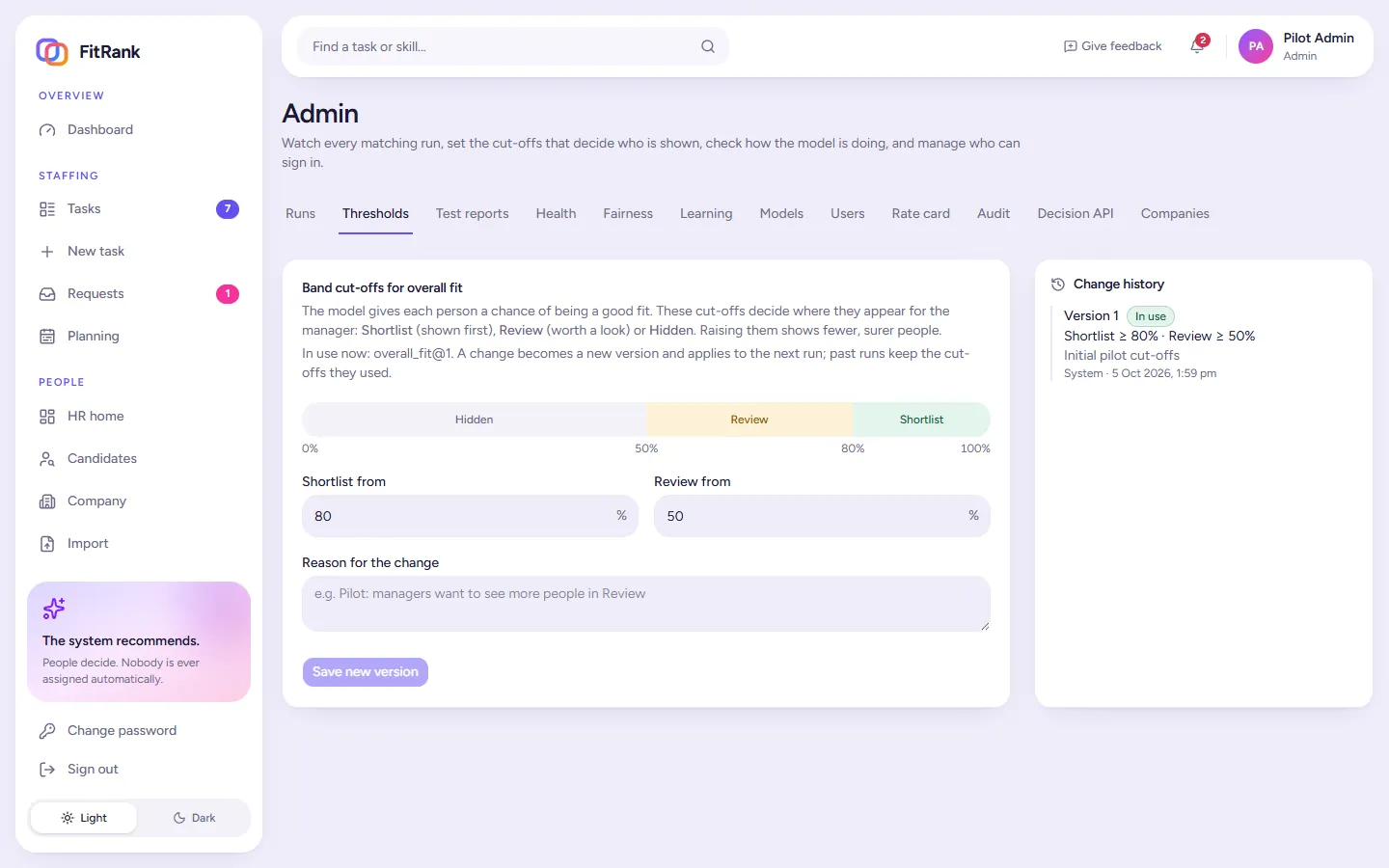 Model governance, health and fairnessSet shortlist cut-offs, switch or roll back model versions behind a safety gate, and track agreement, outcomes and fairness across qualified people.
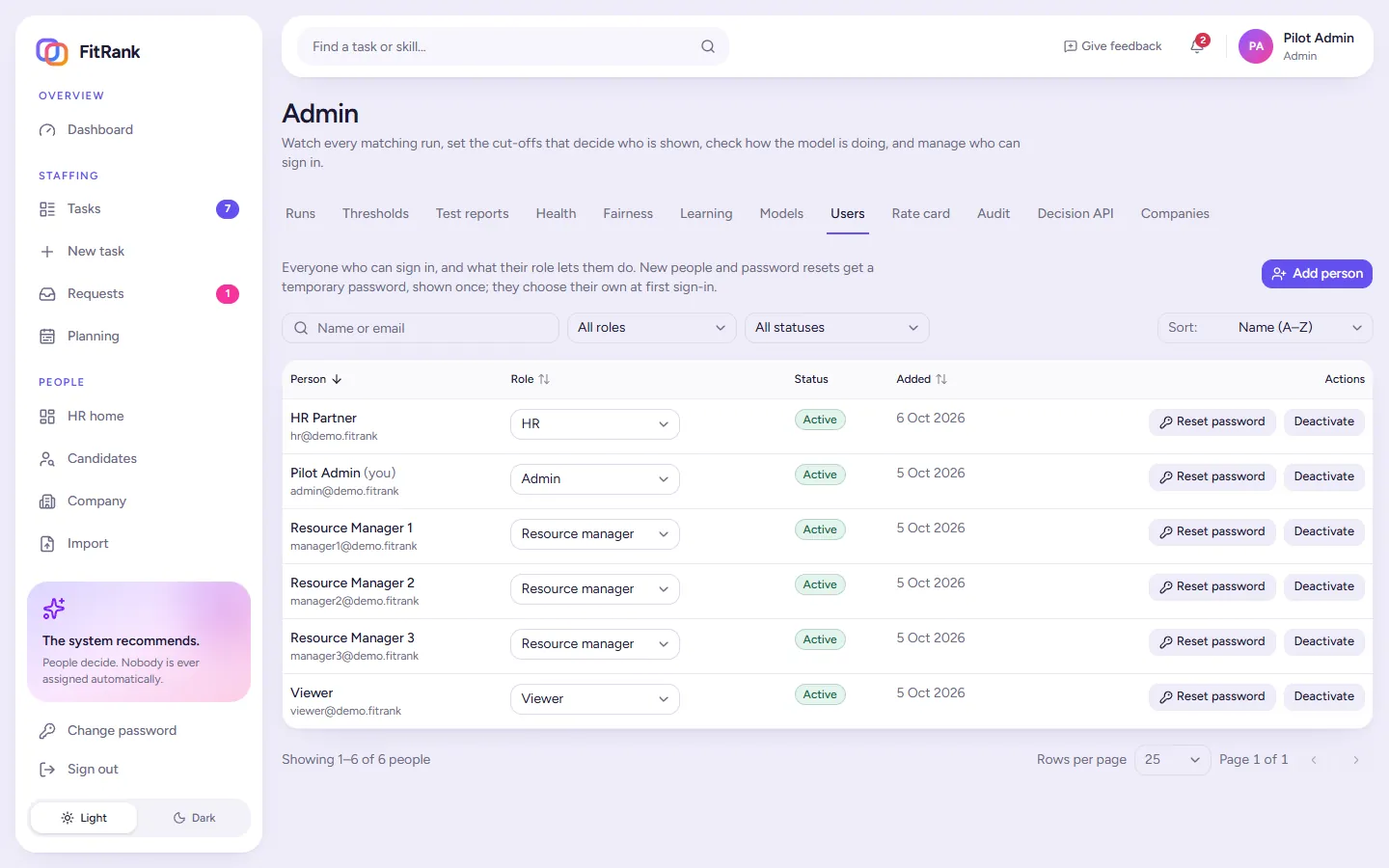 Roles, sign-in and auditAdmin, resource manager, HR and viewer roles, hashed passwords and short-lived tokens, row-level security per company, and an audit CSV of every decision.
More use cases
Be one of the first teams to staff with FitRank
We're taking on a small number of pilot companies. Pre-register for early access, or talk to us about an annual licence.