Skill matrix
Employee skill matrix: format, meaning and where Excel breaks
By Yaseen Khatib, , 4 min read
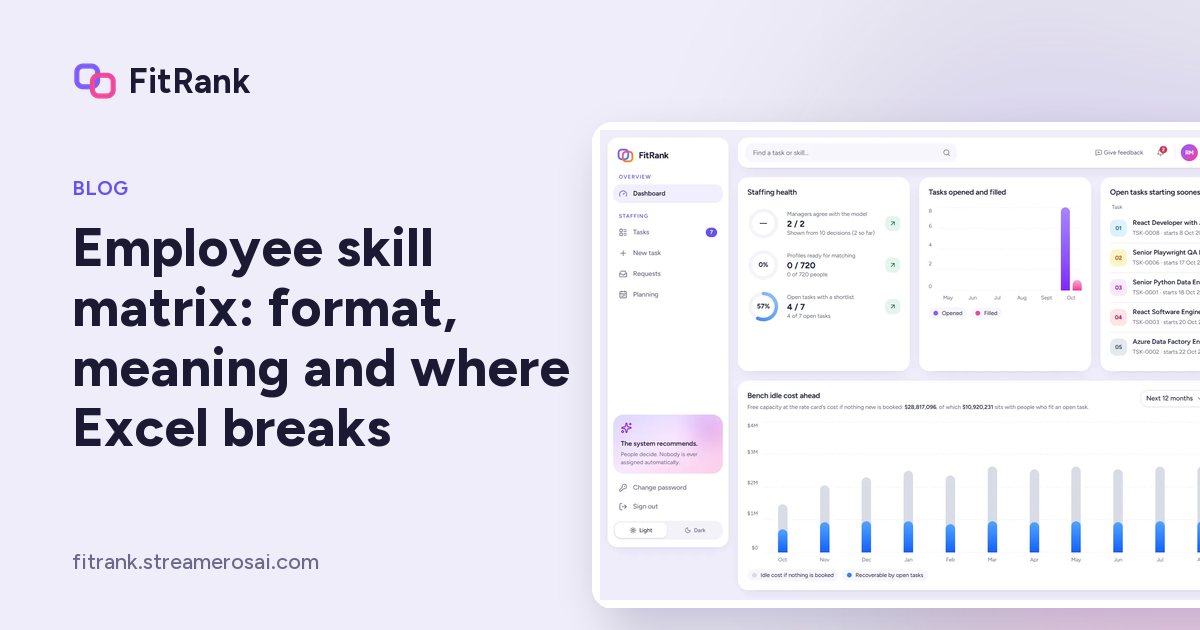
Search for skill matrix and you will find hundreds of Excel templates. That tells you two things: almost every team needs one, and almost every team builds it in a spreadsheet. We did too, before building FitRank.
Skill matrix meaning
A skill matrix is a grid. People go in the rows, skills go in the columns, and each cell says how good that person is at that skill. It answers one question at a glance: who here can do what, and how well?
In IT services it is used for staffing (who can take this project), for training (which skills are thin) and for appraisals (how someone has grown).
A skill matrix format that works
- One row per person, with designation, level and the date they are free for new work.
- One column per skill your projects actually need. Ten to twenty is plenty to start.
- A short rating scale with a written meaning for each number. We use 0 to 4: none, basic, working, strong, expert.
- A total row that counts how many people are strong in each skill. That row is your skill gap view.
- A last reviewed date per row, so you know which ratings are old.
We made exactly this as a free employee skill matrix template in Excel. It has the rating scale, colours and gap totals built in, and it works in Google Sheets too.
Write down what each rating means
Most skill matrices fail on the scale, not the grid. If the numbers have no written meaning, every manager rates differently and the totals mean nothing. Describe each level by what the person can do without help:
- 0, none: has not used it.
- 1, basic: has used it in training or a small task, needs someone to check the work.
- 2, working: delivers ordinary tasks in it alone on a project.
- 3, strong: handles the hard parts, reviews other people's work, can be the only person with this skill on a project.
- 4, expert: designs with it, fixes problems others cannot, and could teach it.
Two rules keep the scale honest. A rating of 3 or 4 needs evidence: a project where the person did that level of work. And a rating should say when the skill was last used, because a strong rating from five years ago is not the same as one from last month.
Reading the gap row: a worked example
Take a made-up team of eight people and three skills a new project needs. Count only ratings of 3 or 4, because those are the people who can carry the skill alone. If Java has five strong people, Kafka has one and Kubernetes has none, the matrix is telling you three different things: Java is covered, Kafka is a key-person risk (one resignation and it is gone), and Kubernetes is a gap. The next step for each is different: nothing, cross-train a second person, and train or hire. The point of the total row is to make that visible before the project starts, not after.
Where an Excel skill matrix breaks
- Ratings go stale. People are rated once, and the sheet says the same thing for two years.
- Ratings are inconsistent. One manager's 4 is another manager's 3, and self-ratings drift high or low.
- It has no history. It cannot tell someone who used React last month from someone who used it five years ago.
- It cannot match. Finding the right person for a project still means filtering columns by hand and asking around.
- It does not scale. Past a few dozen people and skills, nobody reads the whole grid.
How FitRank approaches it
FitRank keeps the same idea, people against skills, but each skill on a profile carries a level, years of experience and when it was last used. A data-health view counts profiles with missing information and profiles due for their six-monthly review, and an employee's resume can be read into suggested skills that HR accepts or dismisses one by one. Then, instead of reading a grid, a manager opens an open task and sees the people who fit, with the reason. See people data.
If a spreadsheet works for your team today, use the template. When it stops working, that is the problem we built FitRank for.
More from the blog
Be one of the first teams to staff with FitRank
We're taking on a small number of pilot companies. Pre-register for early access, or talk to us about an annual licence.