In most IT services companies there is a team everyone calls RMG. Delivery managers message them when a project needs people, HR talks to them before hiring, and finance asks them why the bench is so high. Outside the industry, hardly anyone knows what the job is.
RMG full form
RMG stands for Resource Management Group. Some companies call it the resource management team or workforce management. It is the team that decides, or helps decide, who works on which project and when.
Resource manager job description
A typical resource manager job description in IT services covers most of this:
- Take staffing requests from delivery and account teams: role, skills, level, start date and location.
- Find the right people inside the company first, from the bench and from people rolling off projects.
- Track utilization and bench, and report bench cost to leadership.
- Plan ahead with sales: which deals may close and which skills they will need.
- Raise hiring requests to HR when nobody inside fits, with a clear requirement.
- Keep employee skill and availability data reasonably current.
- Keep it fair, so the same few people do not get every good project.
What a week in RMG looks like
- Start of the week: collect new requests and check each one is complete. A request without a start date, level or location cannot be matched, so it goes back to the manager.
- Every day: match requests against the bench and against people whose projects end soon, then negotiate with the managers on both sides.
- Midweek: review the pipeline with sales, because a deal that closes next month needs people who are free next month, not today.
- End of the week: review the bench by name, with how long each person has been free, and agree one next step for each: a task, a hold for a known deal, or training.
How a resource manager is measured
The numbers differ by company, but these come up in most RMG reviews. Agree the definitions before anyone is judged on them:
- Billable utilization: billed hours divided by available hours. See utilization vs billable utilization for the formula.
- Bench age: how long each person has been without billable work. An average hides the people who have waited longest, so track it by name.
- Time to fill: days from a complete request to a confirmed person.
- Internal fill rate: requests filled by people already in the company, divided by all requests filled.
Skills a resource manager needs
- Enough technical understanding to tell a React developer from a React Native one.
- Negotiation, because delivery managers rarely want to give up good people.
- Comfort with data: utilization, bench age, forecast against actual.
- Calm under pressure. Most requests are urgent, and many arrive at once.
Why the role is hard
Resource managers are measured on utilization and bench cost, but they control neither the projects nor the people. Their data lives in an HRMS that is out of date, a project tracker and managers' heads. Most of the day goes into calls and spreadsheets to answer one question: who is free, and who fits?
How FitRank helps a resource manager
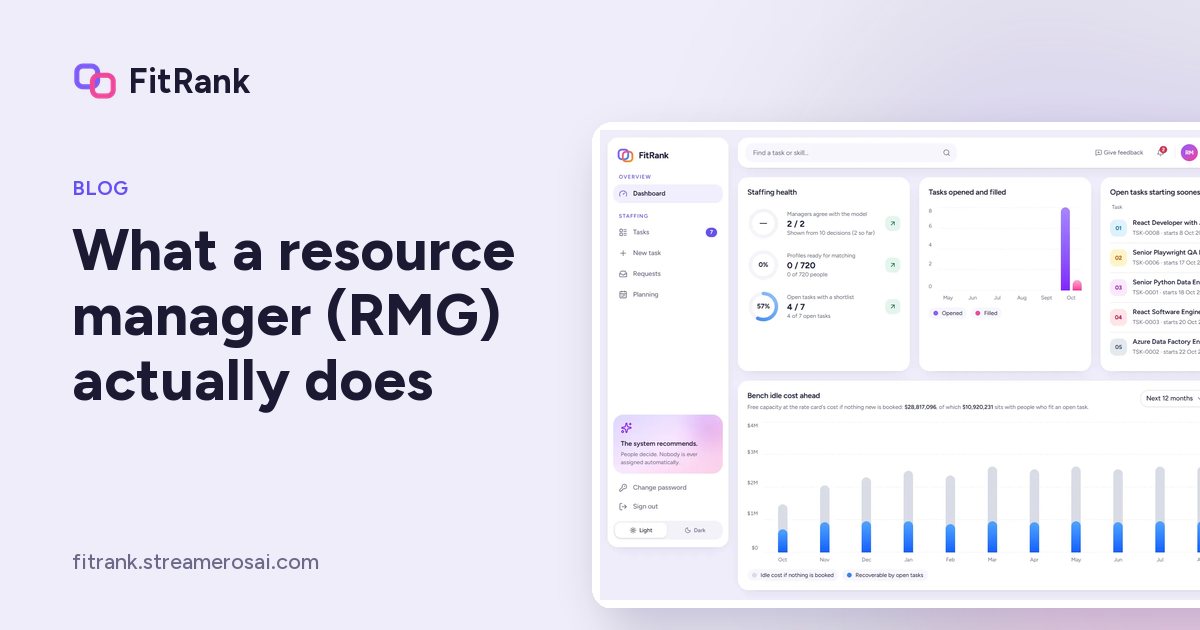
FitRank is built for that question. It keeps a ranked list of who fits each open task with the reasons, shows who is free now or within 30, 60 or 90 days with the weekly idle cost from your rate card, warns about people rolling off projects, and lets a manager hand a task to HR when nobody inside fits. Resource managers still decide; they start from a shortlist instead of a blank sheet. See bench management and hiring requests and candidate matching.
More from the blog
Be one of the first teams to staff with FitRank
We're taking on a small number of pilot companies. Pre-register for early access, or talk to us about an annual licence.